Key Takeaways
- Licensing and ownership have shifted across the board: Terraform moved to a Business Source License in 2023 and IBM completed its acquisition of HashiCorp in early 2025, which pushed a meaningful share of practitioners toward the fully open-source OpenTofu fork.
- Atlassian stopped selling new Bamboo licenses in March 2026, with full end of life set for March 2029, so teams still running it need a migration plan now, not later.
- Puppet is now owned by Perforce and Chef by Progress Software, both acquired years ago, and both continue to operate as standalone product lines rather than being folded into a single suite.
- Pricing has moved toward usage-based and credit-based models almost everywhere: CircleCI bills in compute credits, Terraform Cloud (now HCP Terraform) bills per managed resource, and Grafana Cloud bills per metric series and per gigabyte ingested.
- Free tiers are shrinking. HCP Terraform's long-standing free plan ended in March 2026 and was replaced with a smaller 500-resource cap, and several other vendors have tightened what is included at no cost.
- Open-source and self-hosted options like Jenkins, Prometheus, Kubernetes, and Ansible's community edition remain free to run, though the operational overhead of maintaining them yourself is the real cost to weigh against a managed alternative.
A lot can happen to a tools list in a year. Vendors get acquired, licenses change, free tiers quietly disappear, and a tool that used to be the default choice sometimes gets replaced by something built by the community in response. That is exactly what has happened across this list since we last covered it. Terraform's license change pushed a real slice of its user base toward OpenTofu. Atlassian stopped selling new Bamboo licenses. Puppet and Chef are both owned by different parent companies than the ones that built them. None of that shows up if you just skim feature lists, so this refresh focuses on what these tools cost today, what version or ownership state they are actually in, and where the honest trade-offs sit.
DevOps automation tools remain the backbone of how modern engineering teams build, test, and ship software. They cover everything from code integration and configuration management to container orchestration, infrastructure provisioning, and observability. What has changed is not the categories, it is who owns the tools in each category, and what you will actually be billed for using them. Here is where each one stands in 2026, along with the DevOps automation DevOps Automation fundamentals that still hold true regardless of which vendor you pick.
15 Best DevOps Automation Tools in 2026
1. Jenkins
Jenkins is an open-source automation server facilitating continuous integration and delivery pipelines. Its user-friendly interface and extensive plugin ecosystem empower teams to automate building, testing, and deployment of software. Jenkins is widely adopted by organizations building scalable CI/CD pipelines and is often implemented as part of comprehensive open source development services, helping teams customize, integrate, and maintain enterprise-grade DevOps workflows.
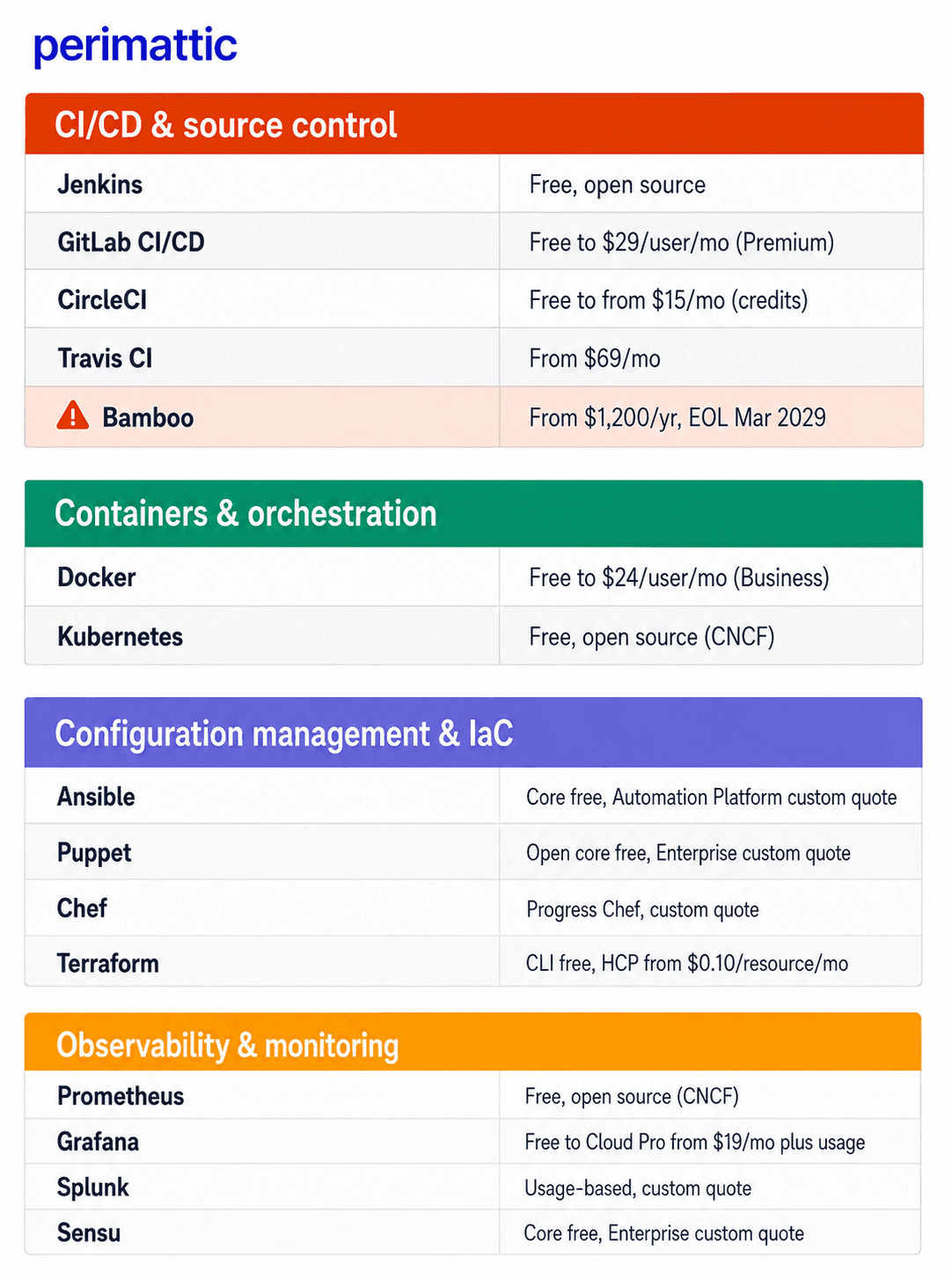
Pricing: Free and open source. You only pay for the infrastructure you run it on and, realistically, the engineering time it takes to maintain it, which is the trade-off teams should weigh honestly against a managed CI/CD platform.
Version and status: Jenkins ships weekly releases plus a more stable Long-Term Support (LTS) line roughly every 12 weeks, and it remains actively maintained under the Continuous Delivery Foundation. It is also frequently implemented as part of broader open source development services engagements, since customizing and maintaining it well takes real expertise.
Key Features of Jenkins:
- Automates the integration of code changes into a shared repository.
- Defines CI/CD pipelines as code, enabling version control and reproducibility.
- Customizes workflows with a vast plugin ecosystem for integration with nearly any tool in the DevOps stack.
2. Ansible
Ansible is an open-source automation tool for configuration management, application deployment, and orchestration, distinguished by its agentless architecture and YAML-based playbooks.
Pricing: Ansible Core remains free and open source. Red Hat's commercial offering, Ansible Automation Platform, is subscription-based and priced per managed node, with Red Hat not publishing a public price list, so expect to request a quote based on your node count and support tier.
Version and status: Now part of Red Hat (an IBM company) since its 2015 acquisition, Ansible Automation Platform continues to ship regular releases with expanded automation analytics, execution environments, and event-driven automation capabilities layered on top of the free core engine.
Key Features of Ansible:
- No agents required on managed nodes, reducing overhead and simplifying setup.
- Defines tasks and configurations in YAML for easy readability and maintenance.
- Ensures consistent system state by only making necessary changes, an approach known as idempotency.
3. Docker
Docker is a popular containerization platform that enables developers to package, distribute, and run applications in lightweight, portable containers.
Pricing: Docker runs a four-tier, per-user subscription model: Personal is free but restricted for larger commercial use, Pro runs roughly $9 to $11 per month, Team runs around $15 to $16 per user per month, and Business runs about $24 per user per month. Since late 2024, Docker has bundled Docker Desktop, Docker Hub, Build Cloud, and Scout into unified subscriptions rather than separate line items.
Version and status: Docker Engine and Docker Desktop continue on frequent release cycles. Worth noting for procurement: any company with 250 or more employees or over $10 million in annual revenue is required to move off the free Personal tier for commercial use.
Key Features of Docker:
- Isolates applications and dependencies into containers for consistency and reproducibility.
- Runs containers on any infrastructure, from local development environments to cloud platforms.
- Utilizes system resources efficiently by sharing the host OS kernel across containers.
4. Kubernetes
Kubernetes (K8s) is the open-source container orchestration platform that automates the deployment, scaling, and management of containerized applications, and it remains the de facto standard that most platform engineering teams build their internal developer platforms around.
Pricing: Kubernetes itself is free and open source, governed by the Cloud Native Computing Foundation. Your real cost is the managed offering you run it on, EKS, AKS, GKE, or a self-managed cluster, plus the compute and storage those clusters consume.
Version and status: Kubernetes ships three minor releases a year, and each minor version is supported for roughly 14 months under the current release cadence, so staying within one or two versions of the latest release is important for security patches and continued cloud-provider support.
Key Features of Kubernetes:
- Automates the deployment, scaling, and management of containers across clusters of hosts.
- Automatically routes traffic to containers and distributes load across the cluster.
- Automatically restarts failed containers and replaces those that do not respond to health checks.
5. Puppet
Puppet is a configuration management tool that automates the provisioning, configuration, and management of IT infrastructure using a declarative, model-driven approach.
Pricing: Puppet Enterprise pricing is node-based and quote-only through Perforce, which does not publish a public price list. The open-source Puppet engine remains free to self-host.
Version and status: Puppet was acquired by Perforce in 2022 and continues to operate as a standalone business unit within Perforce rather than being merged into a different product line. It sits alongside Ansible, Chef, and SaltStack as one of the original configuration management tools, all four of which are now owned by larger parent companies.
Key Features of Puppet:
- Defines desired system states using Puppet's domain-specific language for straightforward configuration management.
- Tracks and reports on infrastructure configuration changes for compliance and auditing.
- Manages configurations across a wide range of operating systems and cloud environments.
6. Chef
Chef, now sold as Progress Chef, is a configuration management tool that automates the deployment, configuration, and compliance management of infrastructure, with particular strength in regulated industries like financial services and healthcare.
Pricing: Progress Chef is subscription-based and quote-only; pricing is not published publicly and depends on node count and support tier.
Version and status: Chef was acquired by Progress Software in 2020 for roughly $220 million and continues to be developed and sold under the Progress brand, with an emphasis on continuous compliance validation alongside its original configuration management core.
Key Features of Chef:
- Defines infrastructure configurations using Chef's Ruby-based DSL for version-controlled, repeatable deployments.
- Operates in a client-server model, with Chef clients on managed nodes reporting to a central server.
- Organizes configuration code into reusable "recipes" and "cookbooks" for modular infrastructure management.
7. Terraform
Terraform remains the most widely used infrastructure as code (IaC) tool for defining and provisioning resources across cloud providers, but its licensing and ownership have both changed significantly since 2023.
Pricing: The Terraform CLI itself is free to run. The managed platform, rebranded from Terraform Cloud to HCP Terraform, now bills on a Resources Under Management (RUM) model: a Free plan covers up to 500 managed resources, Essentials runs about $0.10 per resource per month, Standard runs about $0.47 per resource per month, and Premium runs about $0.99 per resource per month. Importantly, the older, more generous legacy free tier was retired on March 31, 2026.
Version and status: In August 2023, HashiCorp relicensed Terraform (along with Vault, Consul, and several other tools) from the open-source Mozilla Public License to the Business Source License, which restricts competitors from offering Terraform as a commercial managed service without a separate agreement. IBM completed its acquisition of HashiCorp in early 2025. In response to the license change, the community launched OpenTofu, a fully open-source fork under the Linux Foundation that has seen fast-growing adoption and now ships some CLI features, like state encryption, ahead of Terraform's own open binary. Teams evaluating IaC tooling in 2026 should weigh both options rather than assuming Terraform is the only path.
Key Features of Terraform:
- Defines infrastructure resources using HashiCorp Configuration Language (HCL) for declarative, repeatable provisioning.
- Automatically provisions, manages, and updates resources across multiple cloud providers and on-premises environments.
- Tracks resource state and manages configuration changes to keep infrastructure consistent and predictable.
8. GitLab CI/CD
GitLab is a comprehensive DevOps platform,DevOps platform that provides a single application combining source control, CI/CD, and security scanning in a single application rather than a standalone pipeline tool.
Pricing: GitLab runs three tiers. Free covers up to five users with 400 CI/CD compute minutes per month and 10 GiB of storage. Premium runs $29 per user per month (billed annually) and adds merge approvals, code quality scanning, and roughly 10,000 CI/CD minutes per month. Ultimate, which adds full security scanning (SAST, DAST, dependency scanning), compliance management, and portfolio planning, has moved to custom, quote-based pricing rather than a fixed public rate. GitLab Duo, its AI assistant, is billed separately on top of either paid tier.
Version and status: GitLab continues shipping monthly releases with steady investment in its security and AI tooling, and it remains one of the few platforms that bundles source control, CI/CD, and application security scanning under one subscription rather than requiring separate tools.
Key Features of GitLab:
- Built-in Git repository management with branching, merging, and code review.
- Automated testing and deployment pipelines integrated directly into the platform.
- Built-in issue tracking for managing tasks, bugs, and feature requests alongside code.
9. CircleCI
CircleCI is a continuous integration and continuous delivery (CI/CD) platform that automates the software development process, and its pricing model has shifted to a credit-based system that is worth understanding before you commit.
Pricing: CircleCI bills by compute credits rather than flat per-minute rates. The Free plan includes 30,000 credits per month, roughly 3,000 minutes on its default Medium Linux resource class, for up to five users. The Performance plan starts at $15 per month, which includes those same 30,000 credits and five active users, with each additional user costing $15 per month and extra credit packs priced at about $15 per 25,000 credits. A Scale plan and a self-hosted Server option are available for larger organizations.
Version and status: CircleCI's credit system means your real monthly cost depends heavily on which resource class you run, macOS jobs, for instance, burn credits at ten to forty times the rate of standard Linux jobs, so it is worth modeling actual usage before comparing it against flat-rate competitors.
Key Features of CircleCI:
- Easily scales CI/CD pipelines from small teams to large enterprises.
- Fully hosted solution that requires no infrastructure setup or maintenance on the cloud tier.
- Defines workflows and pipelines using YAML configuration files for easy version control and reproducibility.
10. Travis CI
Travis CI is a hosted continuous integration and delivery platform that automates the software development lifecycle, historically popular for its tight GitHub integration.
Pricing: Travis CI's commercial plans start at roughly $69 per month on a per-feature basis, a notable shift from its earlier free open-source tier, which has become far more limited since the platform moved fully under commercial ownership.
Version and status: Travis CI was acquired by Idera in 2019 and continues to operate as a paid product today, but its market share has declined significantly as GitHub Actions, GitLab CI/CD, and CircleCI have captured most of the CI/CD conversation. Teams still on Travis CI's legacy open-source usage should confirm their current plan is still supported before relying on it for anything production-critical.
Key Features of Travis CI:
- Hosted solution that eliminates the need for managing infrastructure, enabling quick setup and deployment.
- Seamless integration with GitHub repositories for automatic builds triggered by code changes.
- Execute tests across multiple versions of programming languages, dependencies, and operating systems simultaneously.
11. Bamboo
Bamboo is Atlassian's CI/CD server, tightly integrated with Jira and Bitbucket, but it is the tool on this list with the clearest expiration date attached to it.
Pricing: Bamboo Data Center is licensed by remote-agent count starting around $1,200 per year, with no free tier. There is no Server edition anymore; Atlassian ended support for Bamboo Server back in February 2024, leaving Data Center as the only option.
Version and status: This is the most important update for anyone still running Bamboo: Atlassian stopped selling new Bamboo licenses as of March 30, 2026, and has set full end of life for March 28, 2029, as part of its broader shift to cloud-only products. If your team is still on Bamboo, this is the year to start planning a migration to GitLab CI/CD, Jenkins, or another CI/CD platform, not the year to renew without a plan.
Key Features of Bamboo:
- Native integration with other Atlassian products like Jira, Bitbucket, and Confluence for end-to-end traceability.
- Defines build configurations and workflows using an intuitive interface or YAML configuration files.
- Executes automated tests as part of the build process to catch issues before release.
12. Prometheus
Prometheus is an open-source monitoring and alerting toolkit built for reliability and scalability, and it remains one of the two foundational pillars, alongside OpenTelemetry, of modern observability stacks.
Pricing: Prometheus itself is free and open source, maintained under the Cloud Native Computing Foundation. Costs come from the infrastructure you run it on and, if you outgrow self-hosting, a managed alternative like Grafana Cloud or a vendor-hosted Prometheus-compatible backend. Version and status: Prometheus continues to see steady adoption growth and now sits alongside OpenTelemetry as one of the most widely deployed observability tools in production, with the two increasingly used together rather than as competitors.
Key Features of Prometheus:
- Stores time series data, making it easy to query and analyze metrics over time.
- Allows flexible querying and aggregation of metrics across multiple dimensions.
- PromQL enables complex queries and calculations directly on collected data.
13. Grafana
Grafana is an open-source analytics and visualization tool that queries, visualizes, and alerts on metrics, logs, and traces from a wide range of data sources.
Pricing: Grafana's core software remains free and open source. Grafana Cloud, the managed SaaS option, uses a consumption-based model: the Free tier includes 10,000 metric series and 50 GB of logs with 14-day retention, Pro adds a roughly $19 per month platform fee plus usage charges (around $6.50 per 1,000 metric series and roughly $0.40 to $0.45 per GB for logs and traces), and Advanced plans start around $25,000 per year for enterprise-scale deployments with extended retention and support.
Version and status: Grafana Labs continues to invest heavily in unifying metrics (Mimir), logs (Loki), and traces (Tempo) under one dashboard layer, and added an AI assistant, Grafana Assistant, to its Cloud offering as a separately billed feature in early 2026.
Key Features of Grafana:
- Connects to a wide range of data sources, including Prometheus, Elasticsearch, and most major cloud monitoring backends.
- Creates custom dashboards with interactive charts, graphs, and tables.
- Uses variables and query expressions to build dynamic, reusable dashboards.
14. Splunk
Splunk remains a powerful platform for searching, analyzing, and visualizing machine-generated data in real time, spanning log management, SIEM, and IT operations monitoring.
Pricing: Splunk offers three main pricing models: ingest-based (priced per GB of data ingested per day), workload-based (priced on compute consumption via Splunk Virtual Compute units), and entity-based. None of these are published as simple, fixed rates, pricing depends heavily on data volume and which modules (like Enterprise Security) you add, and enterprise deployments commonly run into six or seven figures annually at scale.
Version and status: Cisco completed its roughly $28 billion acquisition of Splunk in March 2024, the largest in Cisco's history, and Splunk has continued operating as a distinct product line within Cisco's security portfolio since then, with product integration between the two accelerating through 2025 and 2026.
Key Features of Splunk:
- Ingests and indexes data from a wide range of sources, including logs, metrics, and events.
- Performs ad-hoc searches and complex analysis using Splunk's Search Processing Language (SPL).
- Creates custom dashboards and visualizations to monitor data trends, patterns, and anomalies.
15. Sensu
Sensu is an open-source monitoring tool for servers, applications, and infrastructure health, notable for its lightweight footprint and built-in alert de-duplication.
Pricing: Sensu Core remains free and open source. Sensu's commercial tier, aimed at larger teams needing centralized management and enterprise support, is quote-based.
Version and status: Sensu continues to be maintained as an open-source monitoring option, though it occupies a smaller niche today compared to the combined Prometheus-plus-Grafana stack or full observability platforms, and teams evaluating it in 2026 should weigh it specifically against those more actively growing alternatives.
Key Features of Sensu:
- Manages monitoring configuration and status through a web UI.
- Flexible plugin architecture that is straightforward to extend.
- Built-in de-duplication that reduces alert fatigue from repeated or related failures.
What Changed Most Since Last Year
If there is one theme across this refresh, it is consolidation and licensing pressure. Four of the fifteen tools on this list, Puppet, Chef, Bamboo, and Travis CI, are now owned by companies other than the ones that originally built them, and Terraform's license change plus IBM's acquisition of HashiCorp has visibly split its user base with OpenTofu. Pricing has also moved decisively toward usage-based billing: CircleCI's credits, Terraform's per-resource RUM model, and Grafana Cloud's per-series and per-gigabyte charges all mean your bill now tracks your actual usage far more closely than a flat per-seat price did a few years ago. That is good news if your usage is modest and bad news if it grows quickly without anyone watching it.
Conclusion
Choosing the right mix of these fifteen tools is genuinely harder than it looks, not because the categories have changed, but because the ownership, pricing, and licensing behind each one keeps shifting. Teams that pick a stack and never revisit it tend to get caught off guard, whether that is Bamboo's approaching end of life, Terraform Cloud's shrinking free tier, or a Splunk renewal that costs far more than the original quote suggested.
The fundamentals from the original DevOps playbook still apply: automate everything you reasonably can, remove manual dependencies and individual points of failure, and choose tools that let your team move faster without locking you into a single vendor's roadmap. If you are evaluating whether your current toolchain still fits, or thinking through a platform engineering layer that abstracts some of this complexity away from individual developers, Perimattic's DevOps and platform engineering services team can help you build a GitOps-based pipeline and managed Kubernetes platform without the in-house overhead of running it all yourselves. Book a call if you want a second opinion on where your stack stands today.