


Key Takeaways
- AI development cost spans $5,000 to $2,000,000+, but most genuinely custom projects land between $80,000 and $350,000 for the build alone.
- The biggest cost driver isn't the model, it's data preparation, system integration, and running the system in production.
- Hidden costs (retraining, monitoring, inference) can double your build estimate over three years if not planned for upfront.
- A well-vetted offshore partner, especially in India, can cut costs 60-70% without sacrificing quality.
- Run a proof of concept first, fix your data before development starts, and budget the full three-year cost before committing.
AI Development Services
Every AI project's cost hinges on scope, data readiness, and model choice — talk to our team to see what a production-grade build actually looks like for you.
AI development costs somewhere between $5,000 and $2,000,000+, depending on what you are building. Most projects that are not trivial and not massive land in the $80,000 to $350,000 range for the actual build, before you factor in infrastructure, data work, and everything that happens after launch.
Most vendors skip this part: the average AI project runs 30 to 50% over budget, and most companies underestimate the total cost by two to four times. That is not because AI is unpredictable. It is because the conversation usually stops at the development quote, and nobody mentions what comes next.
This guide is for CTOs, founders, and product managers who want to know how much does AI development cost, start to finish. You will get cost tables, hidden costs, and a straight answer on where budgets go wrong.
AI Development Cost at a Glance
Here are where different types of projects typically land. These numbers cover engineering and design only. Data, infrastructure, and ongoing costs come later.
| Project Type | Typical Cost Range | Timeline | Best For |
|---|---|---|---|
| No-code / Low-code AI tool | $20 - $500/month | 1-4 weeks | Non-technical teams, quick prototypes |
| Pre-built AI integration (API-first) | $5,000 - $30,000 | 4-8 weeks | Chatbots, content tools using GPT or Claude APIs |
| Simple custom AI (chatbot, classifier) | $30,000 - $80,000 | 2-4 months | SMBs wanting tailored NLP or automation |
| Mid-size ML system | $80,000 - $200,000 | 4-8 months | Predictive analytics, recommendation engines |
| Advanced Generative AI app | $150,000 - $500,000 | 6-12 months | Custom LLMs, multi-modal, domain-specific GenAI |
| Enterprise Agentic AI platform | $500,000 - $2,000,000+ | 12-24 months | Autonomous agents, full MLOps, regulatory compliance |
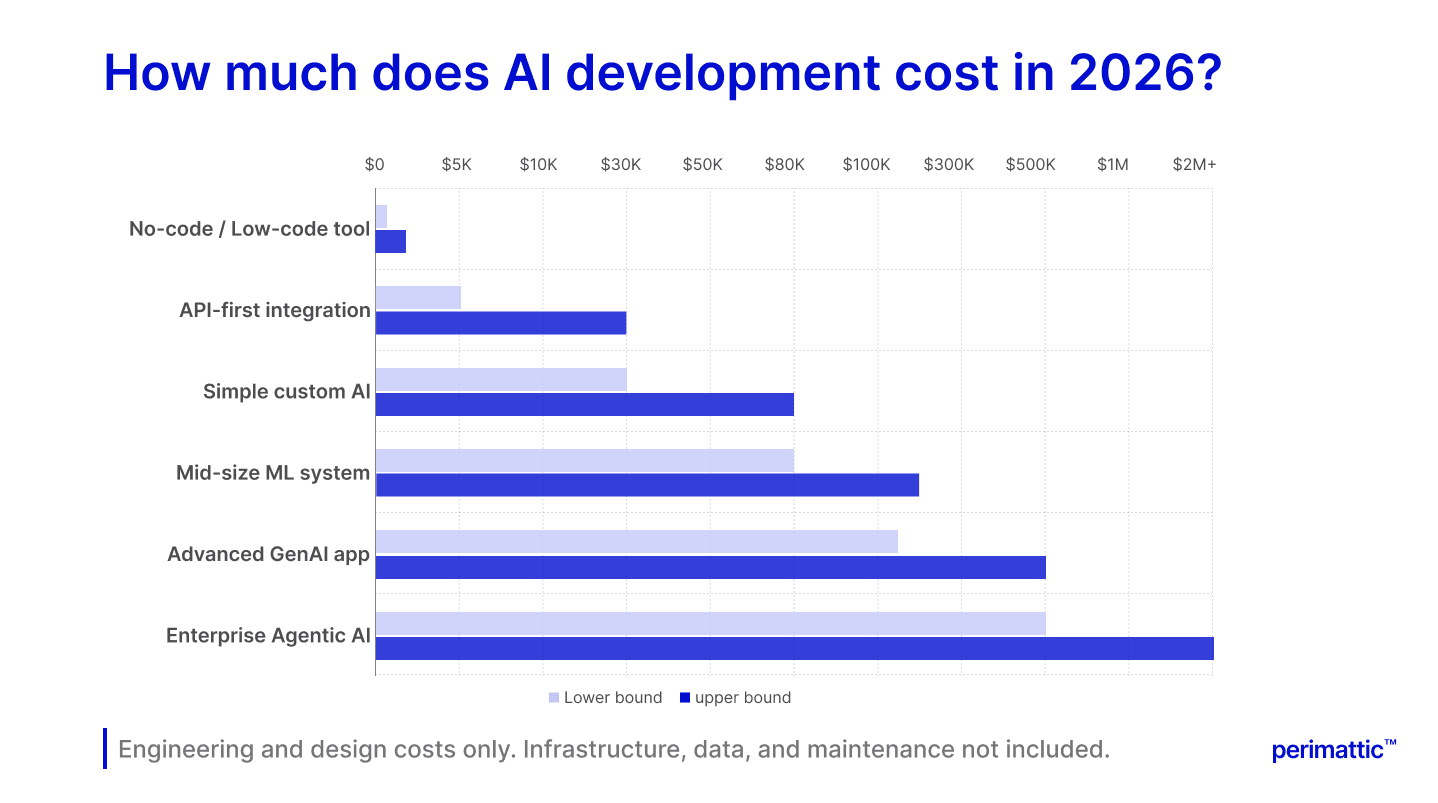
The low end of each range assumes your data is clean, your requirements are clear, and you have a small, focused team. Every tier above no-code will also carry infrastructure and running costs that add 25 to 75% on top over three years. And the agentic AI category is growing at nearly 50% per year right now, but there is almost no honest, published cost guidance for it yet.
What Actually Drives the Price: 8 Key Factors
Price ranges are only useful if you understand what pushes a project toward the top or bottom of them. The same customer service chatbot can cost $20,000 or $200,000 depending on these eight things.
1. Project Complexity & AI Type
A model that predicts which customers are likely to churn is a completely different problem from an AI that reads documents, decides what to do next, and takes actions on its own. The gap in cost and complexity between those two is massive.
In 2026, the rough tiers are:
- Predictive / classical ML (forecasting, classification, scoring): simplest and cheapest
- Generative AI (custom LLMs, document tools, RAG pipelines): moderate to expensive
- Agentic AI (systems that reason and act on their own): most complex, most expensive, and requires the most ongoing oversight
Each step adds more data requirements, longer testing, and harder infrastructure to manage.
2. Build vs. Buy vs. Both
In most cases, the right answer in 2026 is neither pure build nor pure buy. It is both.
Training a model from scratch almost never makes sense for a business application. OpenAI, Anthropic, and Google have already done the expensive foundational work. What costs money is building your specific application layer, integrations, and workflows on top of those models.
Connecting an existing foundation model to your data and systems through a custom app layer typically costs 8 to 10 times less than building something equivalent to zero. The downside is that you depend on a third-party model provider and have less control over how the model behaves.
_Only build custom when existing models genuinely cannot do what you need, or when your data privacy rules make using external APIs impossible. _
3. Data Preparation & Quality
This is where most budgets go wrong, and it almost always comes as a surprise.
Getting data ready, cleaning it, labelling it, building the pipelines to move it around, takes up 20 to 45% of the total project time. If you need custom training data, labelling costs can run from $10,000 to $90,000.
Gartner found that 60% AI projects are at risk of being abandoned specifically because the data is not in good enough shape to use. This almost always shows up halfway through the project rather than at the start. Check your data before you scope anything. If it is messy or incomplete, add a data cleanup phase to your budget before development starts.
4. Team Model: In-House vs Agency vs Offshore
Where your team sits has a bigger impact on cost than almost any other single decision. Here is what rates look like right now:
- US in-house senior ML engineer: $150,000 - $210,000 per year in salary and benefits
- Western agency: $100 - $200 per hour
- Eastern European agency: $40 - $80 per hour
- India/offshore partner: $25 - $60 per hour
On a six-month project with four engineers, the gap between a US agency and an Indian partner can be $200,000 to $400,000 for the exact same work. A good Indian development team typically delivers work at 60 to 70% lower cost than a Western agency, with comparable quality.
5. Cloud and Infrastructure
GPU compute got a lot cheaper in 2025, down about 44 percent year-over-year. An NVIDIA H100 on AWS now runs around $3.90 per GPU-hour. That said, infrastructure is still a real line item. A production system handling thousands of API calls per day can cost $2,000 to $15,000 per month in cloud compute alone, before storage, data transfer fees, and tooling.
The main things to budget for: GPU compute for training and fine-tuning, compute for running the model in production, storage for your data and model versions, monitoring tools like MLflow and Datadog, and API and security layers.
6. Connecting It to Your Existing Systems
This is the cost nobody puts in the first quote.
Connecting an AI system to your CRM, ERP, database, or internal tools is almost never simple. Old systems often do not have the APIs or data structures that modern AI tools expect. Building the connectors and data pipelines to bridge that gap can add $20,000 to $60,000 to your budget, more if your tech stack is genuinely old or complicated.
If your AI project needs to read from or write to more than three existing systems, price integration as its own separate line item. Do not let it get buried inside the general development estimate.
7. Compliance
If you are in healthcare, finance, or any other regulated industry, compliance adds real cost that most project estimates ignore.
The EU AI Act, HIPAA, GDPR, and PCI-DSS all require specific things from AI systems: explainability documentation, bias audits, data residency controls, ongoing compliance reports. For healthcare and financial services projects, that typically adds 15 to 30 percent to the total cost. It also extends timelines and creates ongoing costs for audits year after year.
If you are building a regulated space, price compliance from the beginning. Finding out later is far more expensive.
8. Where Your Team Is Located
Where your team is based affects your budget significantly, but it is only one piece of the picture.
Here is what rates look like by region right now:
- **US / Canada: **$100 - $200/hour
- Western Europe: $80 - $150/hour
- Eastern Europe (Ukraine, Poland): $40 - $80/hour
- India: $25 - $60/hour
- Latin America: $30 - $70/hour
The hourly rate tells you the floor, not the total cost. A team in a cheaper region that misunderstands your requirements and delivers the wrong thing twice is more expensive than a pricier team that gets it right the first time.
What determines the outcome is domain expertise in your industry and the ability to communicate clearly, ask the right questions, and flag problems early. Those things are not tied to geography. They are tied to a specific team. Look for them too regardless of where the team sits.
The Costs Nobody Puts in the Quote
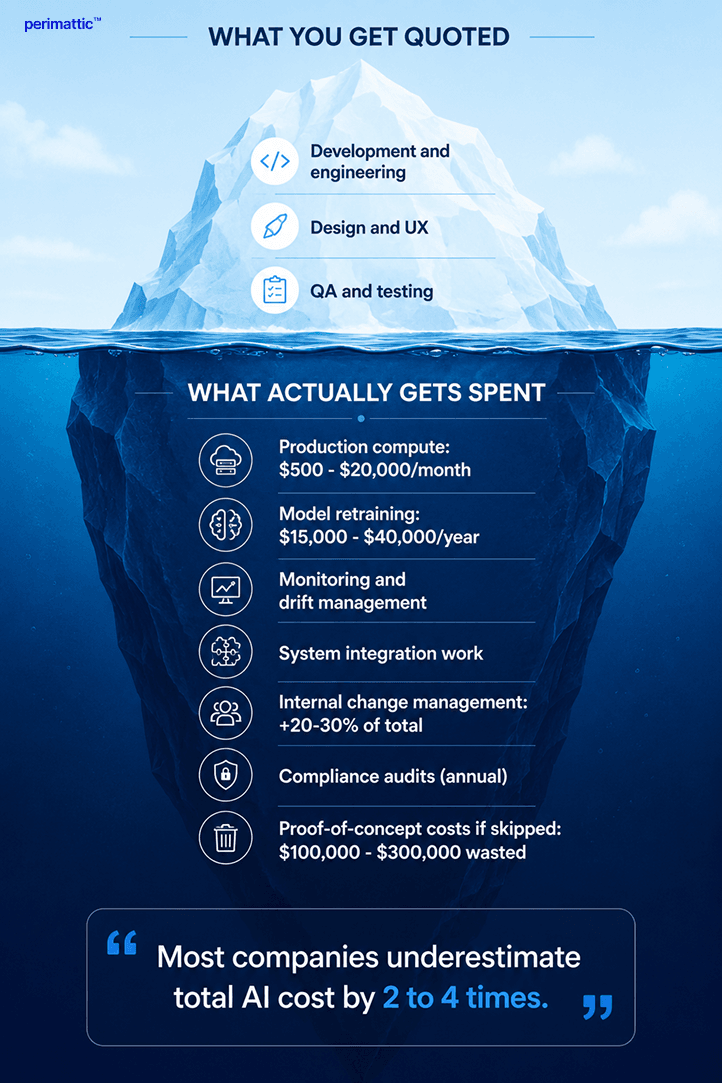
Most AI budgets are wrong before development starts because the quote only covers the visible part. Here is what sits underneath:
- Running costs in production. A chatbot that costs $75,000 to build might cost $6,000 to $10,000 per month to run, depending on traffic. That turns a $75,000 project into a $147,000 first year, before any maintenance.
- **Retraining. **AI models get worse over time as the world changes, and the training data goes stale. Plan to retrain quarterly. That costs $15,000 to $40,000/year for a mid-size model.
- Monitoring. MLOps tools like MLflow, Datadog, and Prometheus cost money every month. The bigger cost is engineering time to watch for problems, investigate when something looks off, and fix it.
- Getting people to actually use it. Building the system is the easier half. Getting your team to trust it, use it, and change how they work around it is the harder half. That process typically adds 20 to 30 percent to the total cost of the program.
- Skipping the proof of concept. A PoC cost $15,000 to $30,000 and takes four to six weeks. Companies that skip it and go straight to production regularly waste $100,000 to $300,000 finding out that their approach does not work.
- Compliance audits. In regulated industries, these are not a one-time cost. Annual audits, bias reviews, and regulatory filings add year after year.
A practical rule: budget 20 to 30% of your initial build cost every year for maintenance, retraining, and updates. If you build something for $200,000, plan to spend $40,000 to $60,000 per year to keep it working.
Total Cost of Ownership (TCO) Over 3 Years
The build quote is just one piece. Here is a real example: a customer service chatbot for a mid-size e-commerce company, using NLP to handle support tickets.
| Cost Category | Estimated Cost | Notes |
|---|---|---|
| Initial Development | $120,000 | Engineering, design, and QA |
| Data Preparation | $30,000 | Cleaning, labelling, pipeline setup |
| Infrastructure (Year 1) | $24,000 | Cloud GPU, storage, monitoring |
| Integration | $25,000 | CRM and ticketing system connectors |
| Year 1 Maintenance | $25,000 | Retraining, bug fixes, updates |
| Year 2-3 Maintenance | $40,000 | Model updates, new features |
| TOTAL (3 Years) | $264,000 | vs. initial build quote of $120,000 |
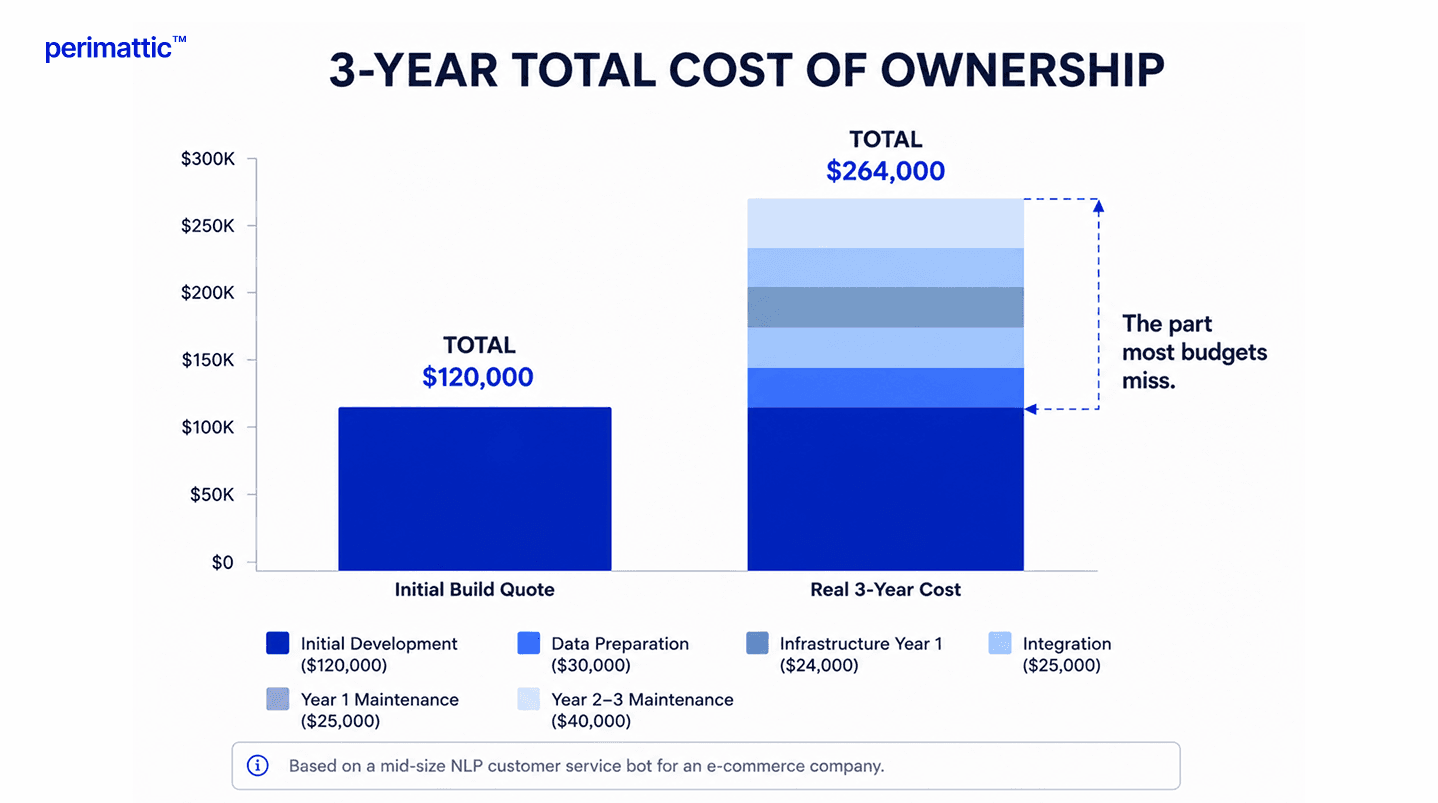
The build quote is $120,000. The real three-year cost is $264,000. That is not an argument against investment. A good customer service AI at an e-commerce company can save well over $500,000 in support costs over three years. But you need to know the real number going in.
AI Cost by Solution Type
Chatbots and Conversational AI
- Simple FAQ bots: $5,000 - $20,000
- Advanced assistants with memory and integrations: $50,000 - $150,000
- Enterprise contact-center AI with voice and routing: $150,000 - $500,000+
Predictive Analytics and Machine Learning
- Basic recommendation engine: $20,000 - $50,000
- Demand forecasting: $60,000 - $150,000
- Real-time fraud detection: $100,000 - $400,000
Computer Vision
- Basic image classification: $15,000 - $40,000
- Object detection or quality inspection: $50,000 - $200,000
- Medical imaging AI: $200,000 - $700,000+
Generative AI
- API-connected content tool: $10,000 - $40,000
- Custom fine-tuned product: $100,000 - $400,000
- Domain-specific LLM: $500,000+
Agentic AI
This is the category most cost articles still do not cover honestly. Agentic AI means systems that can handle multi-step tasks on their own, call external tools, and take actions without someone approving each step. These require more complex architecture, audit trails, and ongoing oversight than a standard AI app.
Production deployments for enterprise use cases run from $200,000 to $2,000,000+ depending on scope and compliance needs. Anyone quoting you under $100,000 for a production-grade agentic system should explain exactly what "agentic" means in their proposal.
Speech and NLP
- Simple speech-to-text: $10,000 - $30,000
- Full voice assistant with custom vocabulary: $50,000 - $200,000
In-House vs. Agency vs. Offshore
There is a genuine shortage of experienced ML engineers right now. In North America, there are roughly 3.2 job openings for every qualified candidate. That makes building a fully in-house team slow and expensive.
| Model | Typical Cost | What You Get | What to Watch For |
|---|---|---|---|
| US In-House Team | $200K - $600K/year | Full control, IP stays internal | Hardest to hire, most expensive |
| US or UK Agency | $100 - $200/hour | High quality, structured process | Premium price |
| Eastern European Agency | $40 - $80/hour | Strong technical skills | Time zone gaps with US |
| India or Southeast Asia | $25 - $60/hour | Large talent pool, English-speaking | Takes more time to find the right partner |
| Hybrid (small internal team + offshore) | 35-55% cheaper | You control strategy, they execute | Needs a good handoff process |
How to Reduce AI Development Costs - 8 Proven Strategies
These are not general tips. Each one reflects a specific decision point were projects regularly waste money.
-
Run a proof of concept first. Spend $15,000 to $30,000 over four to six weeks to test whether your core approach works before you spend $300,000 building it out. A lot of companies skip this to move faster. It is usually a mistake.
-
Use existing models as your foundation. Build on GPT-4, Claude, Gemini, or an open-source alternative rather than training from scratch. This costs 8 to 10 times less in most cases.
-
Fine-tune a smaller model for specific tasks. A 7 billion parameter model that you fine-tune for your specific use case will often outperform GPT-4 on that task, at a fraction of the cost per query. Test this before assuming you need the biggest model available.
-
Fix your data first. The single most common reason AI projects blow their budgets is data problems found halfway through. Cleaning and preparing your data before development starts costs less than fixing it mid-project.
-
Do not over-provision compute. Use spot or preemptible GPU instances for training where occasional interruptions are fine. Use reserved instances for production inference where uptime matters. Teams that pay attention to this typically cut monthly compute costs by 20 to 35%.
-
Set up proper MLOps from day one. Model versioning, automated retraining, monitoring. These feel like overhead early on. They pay for themselves within the first year by cutting maintenance time by 30 to 50 percent.
-
Track your cloud costs like you track revenue. Organizations that actively manage their AI infrastructure spending cut monthly costs by 25 to 30 percent compared to those that do not. This is not a technical change. It is just paying attention.
-
Consider open-source models. Llama, Mistral, and similar models have no API fees and keep your data fully under your control. For companies in regulated industries where sending data to a third-party API creates legal problems, open source is sometimes the only viable option.
AI Development Cost by Industry
Different industries have different cost floors because they come with different data complexity, accuracy requirements, and compliance overhead.
| Industry | Typical Cost Range | What Drives It Up |
|---|---|---|
| Healthcare / Life Sciences | $150,000 - $700,000+ | HIPAA, medical imaging, high accuracy requirements |
| Financial Services | $100,000 - $500,000+ | Real-time fraud detection, PCI-DSS, explainability for regulators |
| E-commerce and Retail | $40,000 - $300,000 | Recommendation engines, demand forecasting, personalization |
| Manufacturing | $80,000 - $400,000 | Predictive maintenance, computer vision inspection |
| HR and Recruiting | $30,000 - $150,000 | Resume screening, bias compliance |
| Education and EdTech | $20,000 - $100,000 | Adaptive learning, tutoring systems |
| Logistics and Supply Chain | $60,000 - $250,000 | Route optimization, demand prediction |
ROI: Is AI Development Worth the Investment?
Here is the honest answer.
MIT research found that 95% of enterprise AI pilots delivered no measurable impact on the bottom line. But the companies that do succeed are not that different from the ones that fail. The difference usually comes down to three things: their data was ready before they started; they had a specific measurable goal, and they built in stages.
When those conditions are met, AI projects in fraud detection, predictive maintenance, customer service, and supply chain work well. Well-run projects in these areas regularly return three to five times the investment, often recovering the full cost within six to twelve months.
- Only about 6% of companies are genuinely good at AI, by research standards. What separates them from everyone else is not a better model. It is cleaner data and clearer goals.
- AI costs are dropping fast. GPU prices fell 44% in 2025. LLM API costs are down about 90 percent from their 2023 peak. The economy gets better every year.
- The real question is not "should we do AI?" It is "which specific problem, with which data, and what does success look like in twelve months?"
How to Budget for an AI Project - 4-Step Framework
Step 1: Get Specific About What You Are Building and What Good Looks Like
AI costs are directly connected to how accurate your system needs to be. Going from 90 percent accuracy to 99 percent accuracy can triple or quintuple the engineering work. Decide what "good enough" means for your use case before you start, not after.
Write down what success looks like in concrete terms: cost per ticket resolved, percentage reduction in manual review time, fraud catch rate. Vague goals produce projects that are impossible to scope and easy to overbuild.
Step 2: Look at Your Data Before You Talk to Any Vendors
Before anyone starts building, you need an honest picture of your data. Is it structured or not? Is it labeled? How much do you have? How consistent is it? If the answer to any of those questions is "not great," build a data preparation phase into your plan and budget before engineering starts.
If your data is in rough shape, assume it will cost twice what you initially estimate to get it ready.
Step 3: Pick the Right Level of Complexity
Start with the simplest architecture that could actually work for your use case. No-code tools first, then API integration on top of an existing model, then fine-tuning, then custom development. Move up that ladder only when you have a concrete reason the simpler option is not good enough.
Most teams default to more complexity than they need because it feels more impressive. This is expensive.
Step 4: Plan the Full Three-Year Cost Before You Commit
Once you have a build estimate, add 15 to 25 percent of that number per year for maintenance, retraining, and infrastructure. Project your running costs at the traffic volume you expect. Make sure you have a PoC plan before you sign anything.
The companies that stay on budget are not the ones with the biggest resources. They are the ones who went in knowing what they were buying.
What to Take Away
AI can cost $5,000 or $2,000,000. The right number for your situation depends on what you are building, what data you have, and who builds it.
- The biggest cost in most AI projects is not the model. It is cleaning data, connecting systems, and keeping things running.
- Hidden costs can double your build estimate over three years if you do not account for them upfront.
- A good development partner in India can cut costs by 60 to 70%. Getting the vetting right matters more than the location.
- AI is getting cheaper every year. The time to start is now, but start with a clear problem and real data, not a vague idea.
- The companies that get the best results from AI are not the ones who spend the most. They are the ones who define the problem clearly, fix their data first, and build in phases.
_Ready to estimate the cost of your AI project? Perimattic's team of AI specialists offers a free 30-minute discovery call to scope your requirements and provide a transparent, no obligation estimate. _