

Key Takeaways
- DevSecOps integrates security into the software development lifecycle, making security a shared responsibility across development and operations instead of a final review step.
- Use SAST, SCA, DAST, and IaC/container scanning to identify different categories of security risks throughout the CI/CD pipeline.
- Security controls should be placed at the right pipeline stages, from code commits and dependency scanning to pre-deployment checks and runtime monitoring.
- Shifting security left works best when paired with clear ownership, finding prioritization, and developer-friendly tooling to avoid creating unnecessary security noise.
- Avoid common DevSecOps mistakes such as tool sprawl, lack of developer ownership, incomplete infrastructure and API security, and failing to retest vulnerabilities after fixes.
- A phased DevSecOps rollout can start with SAST and SCA, followed by IaC and container scanning, DAST, runtime monitoring, and governance.
- Measure DevSecOps effectiveness using metrics such as time to fix vulnerabilities, retest pass rate, pipeline coverage, and security debt trends.
- DevSecOps can also support compliance requirements by continuously generating evidence of security scans, findings, and remediation throughout the development process.
DevOps & Platform Engineering Services
Security built into the pipeline, not bolted on after — our platform engineering team implements the CI/CD security practices this article covers, end to end.
Security used to sit at the very end of the release process, a final review before code shipped, often the thing that got skipped when a deadline was tight. DevSecOps exists because that model stopped working the moment release cycles compressed from months to days. This guide covers what DevSecOps actually means in practice, where security fits into a modern CI/CD pipeline, and what the real-world data says about whether it's worth the investment.
What DevSecOps Actually Means
DevSecOps is the practice of integrating security testing, controls, and accountability directly into the software development lifecycle, rather than treating security as a separate gate that happens after development is "done." The name describes the goal precisely: security becomes a shared responsibility across development and operations, built into the same automated pipelines that already handle testing and deployment, instead of a standalone team that reviews finished work.
In practice, this means security scanning runs automatically on every commit, vulnerable dependencies get flagged before they're merged, infrastructure configurations get checked against policy before they're provisioned, and developers see security findings in the same tools they already use for code review, rather than in a separate report that arrives weeks later.
Why the Economics Actually Favor Doing This
The business case for DevSecOps isn't just a "best practice" argument, it shows up directly in breach cost data. IBM's Cost of a Data Breach Report 2025 identifies DevSecOps as the single largest cost mitigator across all breach scenarios studied, associated with a $227,192 reduction in average breach cost, ahead of AI and ML security insights and security analytics. Organizations with high DevSecOps adoption saved approximately $1.7 million per breach compared to those with low adoption, against a global average breach cost of $4.44 million, a reduction of roughly 38%.
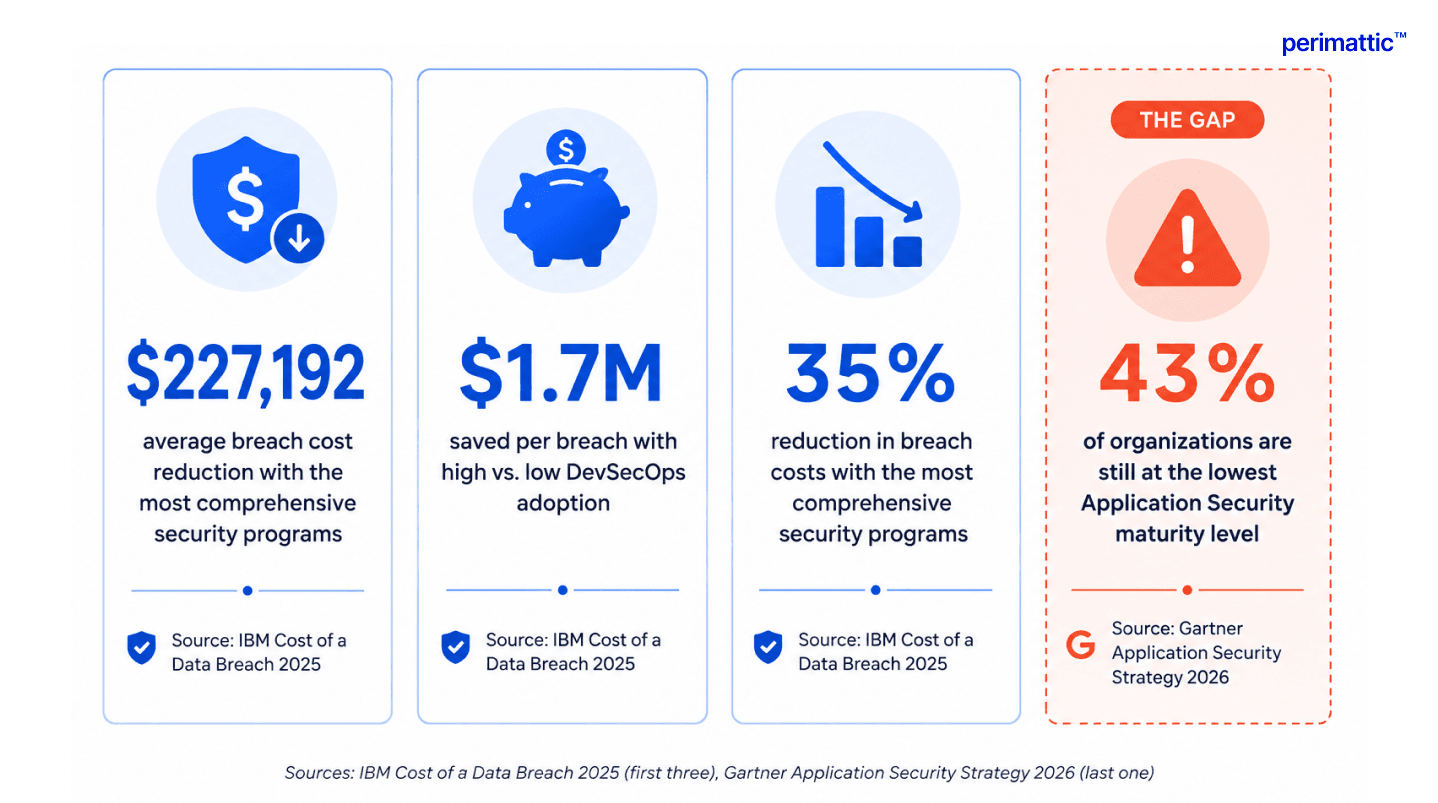
At the same time, application security maturity across the industry is lower than the pace of software delivery would suggest. Gartner's Application Security Strategy 2026 report found that 43% of organizations are still at the lowest maturity level for application security, even as development velocity keeps increasing. That gap, between how fast software ships and how mature security practices actually are, is the core problem DevSecOps is meant to close.
The Four Layers of Security in a Modern CI/CD Pipeline
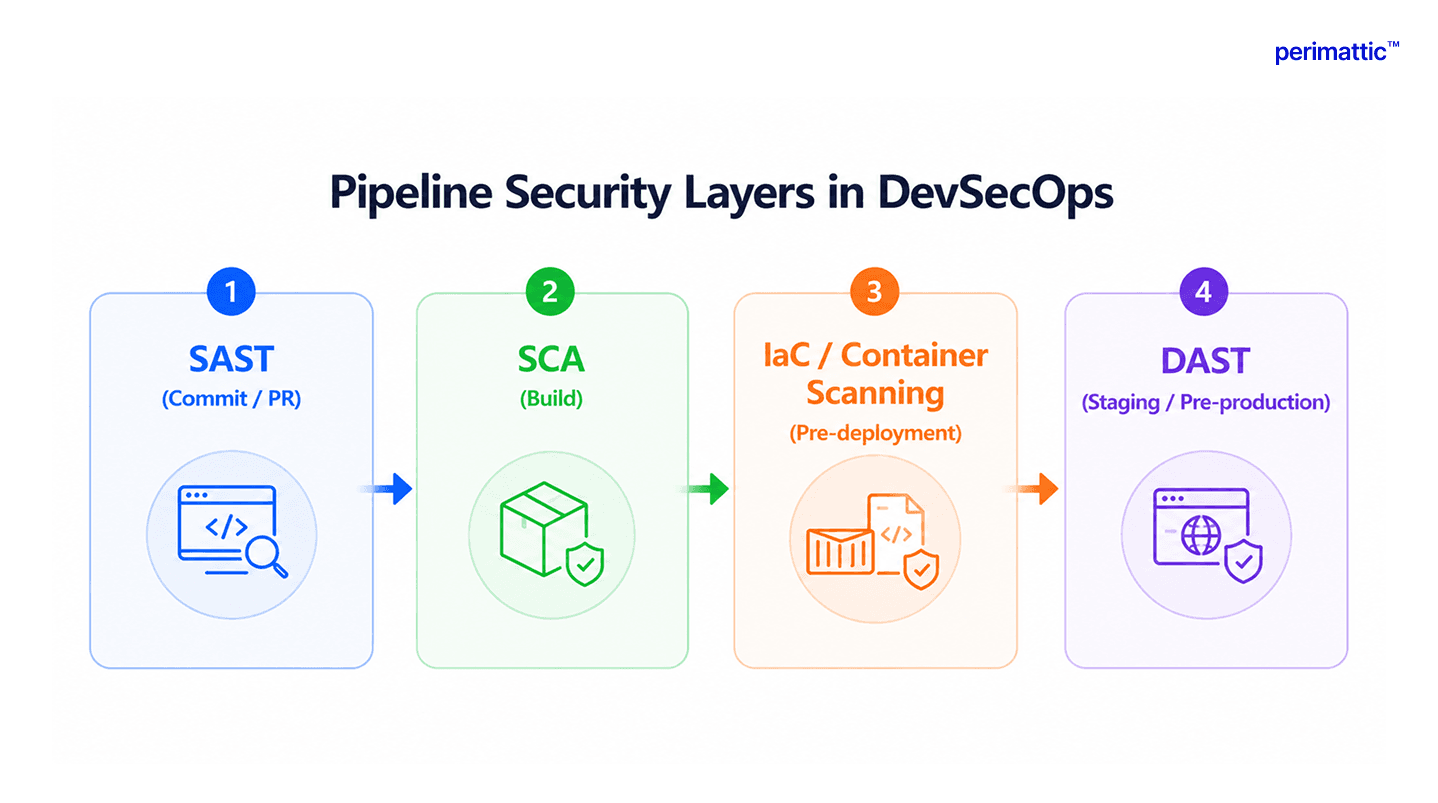
DevSecOps isn't a single tool. It's a set of controls layered across the pipeline, each catching a different category of risk.
Static Application Security Testing (SAST) scans source code for known vulnerability patterns before it's even compiled, catching issues like injection flaws or insecure coding patterns at the point they're written, inside the developer's own commit or pull request.
Software Composition Analysis (SCA) scans third-party dependencies and open-source libraries for known vulnerabilities and license risks. Given how much of any modern application is built on external packages, this layer often surfaces more risk than code the team wrote themselves.
Dynamic Application Security Testing (DAST) tests a running application from the outside, the way an attacker would, catching issues that only show up at runtime and wouldn't be visible from reading the source code alone.
Infrastructure as Code (IaC) and container scanning checks Terraform, Kubernetes manifests, and container images against security policy before they're deployed, catching misconfigurations, like an overly permissive security group or a container running as root, before they ever reach production.
Where Each Control Fits in the Pipeline
| Pipeline Stage | Security Control | What It Catches |
|---|---|---|
| Commit / pull request | SAST | Insecure coding patterns in first-party code. |
| Build | SCA (dependency scanning) | Known vulnerabilities in third-party libraries. |
| Pre-deployment | IaC and container scanning | Misconfigured infrastructure and insecure container images. |
| Staging / pre-production | DAST | Runtime vulnerabilities visible only in a running application. |
| Production | Secrets management and runtime monitoring | Credential exposure and anomalous behavior after deployment. |
Shift Left, and the More Recent "Shift Down" Reframe
For years, the standard advice was to "shift left," move security testing as early in the pipeline as possible so issues get caught before they're expensive to fix. That advice is still broadly correct, but Gartner's more recent research adds an important nuance: shifting left without also shifting responsibility and tooling appropriately just moves the bottleneck rather than removing it. If developers are handed a flood of security findings with no prioritization, no clear ownership, and no support for actually fixing them, shift-left becomes what Gartner calls "alert relocation" rather than genuine risk reduction.
The practical implication is that DevSecOps has to include not just earlier detection, but also noise reduction (prioritizing findings that actually matter), clear ownership (who fixes what, and by when), and integration into tools developers already use, rather than a separate dashboard nobody checks. This is exactly the kind of pipeline design work covered under enterprise DevOps consulting, where security automation gets built alongside the CI/CD pipeline itself rather than bolted on afterward.
Common Mistakes When Adopting DevSecOps
Tool sprawl without ownership. Adding SAST, SCA, DAST, and container scanning tools is the easy part. The harder part is making sure every finding has a clear owner and a path to resolution, otherwise the tools generate noise that gets ignored, and the organization ends up with the appearance of security maturity without the substance.
Treating DevSecOps as a security-team-only initiative. DevSecOps only works if developers are genuinely accountable for fixing what gets found, not just informed about it. Programs that don't get developer buy-in tend to see findings pile up unaddressed, regardless of how good the scanning tools are.
Skipping infrastructure and API-layer security. It's common for teams to secure application code thoroughly while leaving infrastructure configuration and API endpoints comparatively unguarded. A comprehensive approach to API security needs to sit alongside application-level scanning, not as an afterthought, since APIs are frequently the actual attack surface in a breach.
No retesting loop. Finding a vulnerability and confirming it was actually fixed are two different steps. Mature DevSecOps programs build retesting into the pipeline, so a fix gets validated automatically rather than assumed to have worked.
Building a DevSecOps Roadmap
A realistic rollout tends to follow a sequence rather than trying to implement everything simultaneously:
- Baseline the current state. Understand what security testing, if any, already happens, and where the biggest gaps are, before adding new tooling on top of an unclear foundation.
- Start with SAST and SCA. These integrate earliest in the pipeline and tend to have the clearest, most actionable findings for developers to act on directly.
- Add IaC and container scanning as infrastructure-as-code and containerized deployments mature, since misconfigurations here can be as costly as application-level vulnerabilities.
- Layer in DAST and runtime monitoring once the earlier stages are catching and resolving findings reliably, extending coverage to what only shows up in a running system.
- Build the governance layer, ownership, SLAs for fixing findings by severity, and retesting, so the program keeps working as the codebase and team grow, rather than degrading back into a tool-heavy but effectively unmanaged state.
This kind of phased rollout, paired with Azure DevOps consulting or an equivalent platform-specific implementation, tends to produce security guardrails that developers actually work with instead of around.
Measuring Whether a DevSecOps Program Is Actually Working
Tool adoption is easy to report on and doesn't, by itself, prove much. A few metrics do a better job of showing whether a program is actually reducing risk:
Time from finding to fix, tracked by severity, shows whether vulnerabilities are being resolved at a pace that matches their risk, not just detected and logged. A program that finds issues quickly but takes months to resolve critical findings hasn't meaningfully reduced its exposure.
Retest pass rate measures how often a "fixed" finding actually stays fixed on the next scan, catching the common failure mode where a fix is applied but doesn't fully resolve the underlying issue.
Percentage of critical applications with full pipeline coverage, since partial coverage, where the highest-risk applications are somehow the ones without complete scanning, is a common and dangerous gap that aggregate adoption numbers tend to hide.
Security debt trend, the total count and age of unresolved findings over time, is often a better signal than any single point-in-time metric, since it shows whether the backlog is shrinking or just being managed at a steady, uncomfortable size.
Programs that track these outcome metrics tend to catch problems, like a specific team's fixes not passing retest, or one critical application slipping through scanning coverage, long before those gaps would otherwise surface as an actual incident.
DevSecOps and Compliance
For regulated industries, DevSecOps isn't only a cost and risk conversation, it's increasingly a compliance requirement. Frameworks like SOC 2, HIPAA, and PCI DSS all expect demonstrable, continuous evidence of security controls, not a point-in-time audit that gets refreshed once a year. A pipeline that automatically generates evidence of scanning, findings, and remediation as a natural byproduct of shipping code puts an organization in a much stronger audit position than one that has to reconstruct that evidence manually after the fact. This is part of why the broader web development security checklist approach, covering everything from TLS configuration to dependency patching, works best when it's automated into the pipeline rather than treated as a periodic manual review.
Regulatory pressure is also part of why DevSecOps adoption keeps accelerating industry-wide. Requirements like software bill-of-materials (SBOM) attestation for software supply chains and expanding breach notification rules have pushed security from a periodic checkpoint into something that has to be continuously demonstrable, which is exactly the operating model DevSecOps is built to support.
Conclusion
DevSecOps isn't really a tooling decision, it's a decision about where security accountability lives. The data makes a clear case for building it in early: lower breach costs, faster remediation, and fewer surprises late in the release cycle. But the tooling alone doesn't get you there. The organizations seeing real results are the ones that pair automated scanning with clear ownership, manageable alert volume, and a retesting loop that confirms fixes work, not just the ones with the most scanners running in their pipeline.