
Key Takeaways
- There's no single "best" language, there's a stack. Production AI systems are polyglot by default: Python for modeling, TypeScript/Node for the application layer, Java/.NET for legacy integration, and C++/Rust only when there's a genuine latency requirement.
- Python dominates model development, not the whole system. Its concurrency limits, latency ceilings, and dependency sprawl mean production teams typically wrap the model in a separate serving layer rather than running pure Python end to end.
- The application layer is the most overlooked piece. Most enterprises already run Node.js or TypeScript for their product, and AI has to plug into that existing stack, not replace it, or "we added AI" never becomes more than a demo.
- Legacy Java and .NET systems aren't a language debate, they're an integration problem. Connecting a Python-built model to the banking, insurance, or ERP systems already running the business is usually harder than building the model itself.
- Language choice rarely kills an enterprise AI project. More than 80% of AI projects fail to reach production, and the causes are almost always integration gaps, data readiness, or missing governance, not the wrong programming language.
Search "best programming languages for AI" and there is the same list ten times over. Python wins. C++ and Rust show up for performance. Java gets a mention for "enterprise." Every article is written for someone deciding what to learn next.
That's not the question most of our readers are actually asking. If you're scoping an AI project, or trying to figure out whether a vendor knows what they're doing, "which language should I learn" isn't relevant to you at all. The real question is different: which stack lets your team ship an AI system, connect it to what you already run, and still be maintaining it in three years instead of rewriting it.
That's the question this article answers. No ranking, no "Python vs. everything." Just a straight look at where each language earns its place in a production AI system, and where it doesn't.
The short answer
If you've got a minute, here's the shape of it before we go deeper.
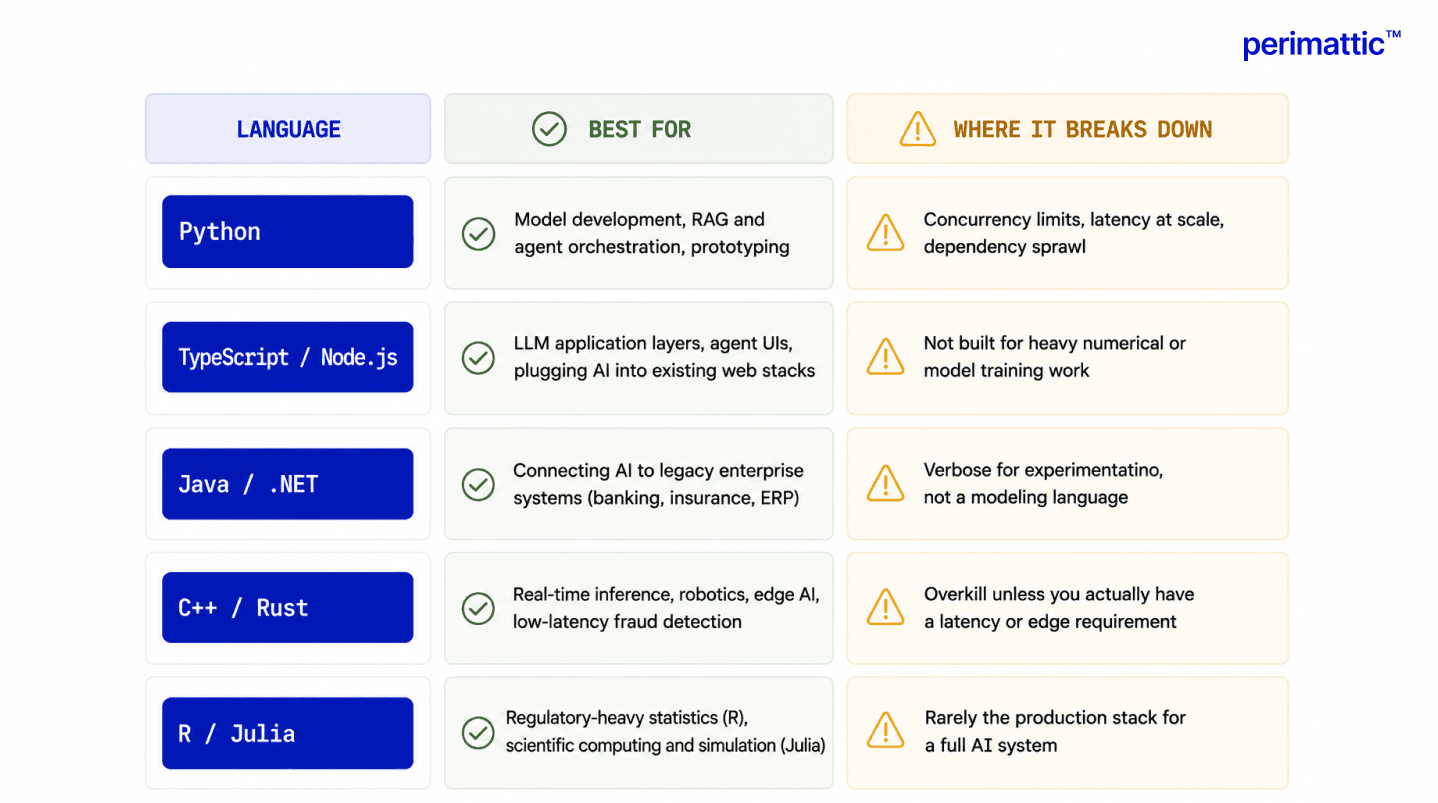
Nobody runs just one of these in a real deployment. Keep reading for why, and for what actually decides whether the project works or not.
Python: the default, and its real limits once you're in production
Python earned its spot the hard way. PyTorch, Hugging Face, LangChain, LlamaIndex, most of the tooling that made modern AI development move fast was written in Python first, and a lot of it still only exists there. Stack Overflow's 2025 Developer Survey found Python usage jumped 7 percentage points from 2024 to 2025, a bigger single-year move than almost any other established language sees, right alongside Rust and Go, which are also tied closely to AI work these days.
For prototyping and model development, there's not much of an argument to have. It's where the research lands first, where the ecosystem is deepest, where you'll find a library someone already built instead of writing one from scratch.
Production is where it gets harder. Python's global interpreter lock puts a ceiling on how well it handles heavy concurrent traffic. Latency-sensitive inference often needs something else sitting underneath it. And past a certain codebase size, dependency management stops being a minor annoyance and starts costing real engineering hours every sprint.
None of that means skip Python. It means production teams rarely run pure Python end to end. The model logic stays in Python. The serving layer, the part actually handling thousands of concurrent requests on a tight latency budget, often moves elsewhere: a Go or Rust service sitting in front of the model, async patterns to squeeze more throughput out of Python itself, or a containerized setup that keeps the model isolated from the parts of the system that need to scale on a different curve. Python is the language of AI development. On its own, it's rarely the language of AI at scale.
TypeScript, JavaScript, and Node.js: the part most lists skip entirely
This is the section most "best AI language" content leaves out, and it's often the most relevant one if you're actually buying or building for an enterprise.
Most companies already run their product on Node.js or some flavor of TypeScript. Their web app, their internal tools, their customer dashboard, all of it. When AI gets bolted onto that product, it almost never replaces the existing stack. It plugs into it. The chat interface, the orchestration layer talking to the model and holding application state, the piece connecting the AI feature to everything else you've built, that's increasingly TypeScript and Node territory.
This matters more than it sounds like it should, because it's where "we added AI" either turns into a real feature or stays a demo nobody ever ships. A model that performs beautifully in a notebook still needs a real application wrapped around it: auth, error handling, state management, a UI someone will click through. That layer must speak the same language as everything else in your codebase, or you've just handed yourself a second system to maintain forever.
It's part of why we build application layers on Next.js and Node here. Not because it's trendy, but because it's the layer most of our clients already have running, and AI needs to meet them there instead of asking them to rebuild around it.
Java, Scala, and .NET: where legacy enterprise systems live
Banking, insurance, manufacturing. A disproportionate share of the systems that actually run those industries sit on the JVM or on .NET, and that isn't changing anytime soon, nor should it. These systems handle regulatory reporting, core transaction processing, and years, sometimes decades, of business logic nobody wants to touch unless they absolutely have to.
So the real decision was never "should we build our AI in Java." It's how do you connect a model built in Python to the Java or .NET systems already running the business, without destabilizing either side. That's an integration problem, not a language preference, and treating it like a language debate is a good way to miss what actually needs solving.
In practice this gets handled through model-serving APIs that expose a Python-trained model behind a clean interface, message queues that keep the AI system decoupled so a slowdown on one side doesn't take down the other, and direct integration work against whatever ERP or core system is already in place. If you're running something like ERPNext and want AI layered on top of it without touching the ERP itself, this is exactly the kind of work involved.
The mistake we see most often is enterprises spending weeks debating a language when the actual hard part, the part that determines whether the project succeeds, is this integration work.
C++ and Rust: performance-critical and edge AI, read this one carefully
There's a real, narrow slice of AI work where this layer earns its place: real-time inference under strict latency budgets, robotics, computer vision running on a factory floor, fraud detection that has to make a call in milliseconds. Rust especially has been picking up steam, developers keep naming it the most admired language in survey after survey, and it's showing up more in inference runtimes and memory-safe infrastructure.
Here's the part most vendor content won't say out loud: unless you actually have one of those latency or edge constraints, you probably don't need this layer at all. Most enterprise AI, especially in banking, healthcare, and logistics, the industries we spend most of our time in, runs fine on Python for the model with a solid integration layer wrapped around it. Reaching for C++ or Rust without a real performance requirement just adds engineering overhead and a harder hiring problem, without buying you anything for it. If someone's pushing this stack on you without pointing to a specific latency need, that's worth asking about.
R and Julia: narrow, legitimate, and usually not your production stack
Two more worth naming honestly, since they both do real work in specific corners and get lumped into these lists without much nuance.
R is still the standard in statistically heavy, regulated fields: clinical research, actuarial work, anywhere the methodology itself has to be transparent and auditable, not just accurate. Julia has a smaller but genuine following in scientific computing and simulation, where its mix of speed and mathematical expressiveness solves a real problem nothing else quite does as cleanly.
Neither one is typically what's running your production AI agent or your customer-facing system. If a team is proposing R or Julia as the backbone of a production deployment outside those specific cases, ask why.
The question enterprises need to answer
Here's the part that gets buried under all the language talk: the language itself rarely kills an enterprise AI project. Integration does. Data readiness does. MLOps and governance, or the lack of them, do.
That's not a hunch. RAND Corporation's research found that more than 80% of AI projects fail to reach meaningful production deployment, roughly double the failure rate of a typical IT project. Look into why, and the answers almost never come back to "we picked the wrong language." They're fragmented data, unclear ownership, a pilot scoped to impress a steering committee instead of solve a real workflow problem, a system that never had monitoring or governance built in from day one.
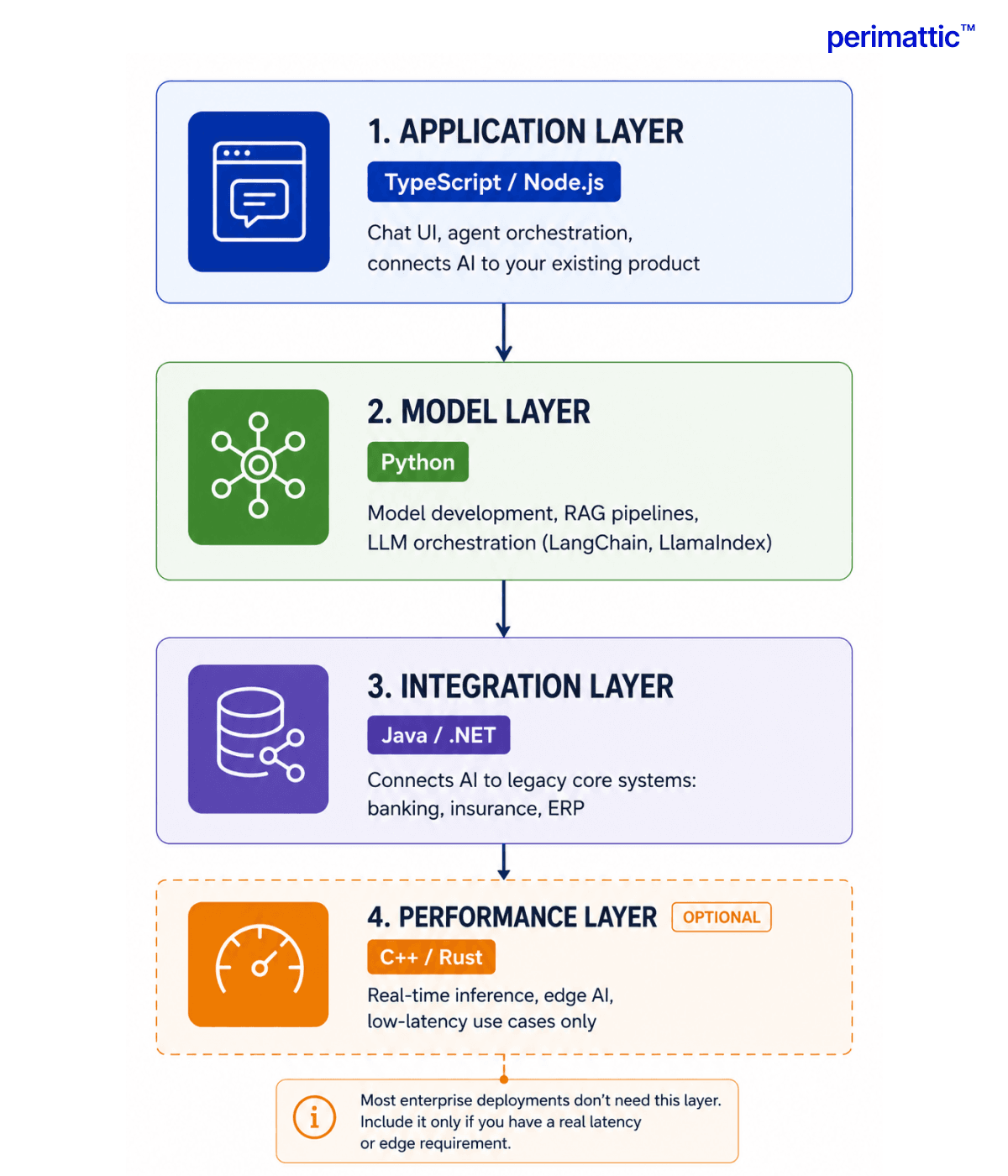
A polyglot stack, Python for modeling and machine learning, TypeScript or Node for the application layer, Java or .NET for legacy integration, isn't a compromise. It's just normal, and honestly it's what you should expect. Trying to force everything into one "best" language is usually a sign someone hasn't built one of these at scale before, not a sign of discipline. The question worth asking a vendor isn't whether they know the best language. It's whether one team can own the whole stack end to end, without handing you off between three specialists who've never spoken to each other.
How to evaluate this when picking a build partner
If you're vetting a team to build production AI, the language they'll use is close to the least interesting question you could ask. Here's what tells you something:
- Can they walk you through, specifically, how the model connects to your existing systems, not in the abstract, but with your actual architecture in mind?
- Who owns data readiness and governance once the thing is live, and what does that look like six months in, not just at launch?
- What's their plan for the gap between a working demo and a system running in production under real load, with monitoring and a way to roll back if something breaks?
- Have they shipped something like this before, and can they tell you what happened after launch, not just how the pilot went?
This is close to how we approach the first stages of any engagement: understand what's already running, map where AI actually fits without disrupting it and be upfront about what it takes to get from a working prototype to something that holds up in production.
The bottom line
Being fluent across Python, TypeScript, Java, and the rest of this stack is table stakes at this point. Any team worth hiring should have it. What separates a project that ships from one stuck in pilot purgatory forever isn't which language sits at the center of the architecture diagram. It's the discipline behind data readiness, integration, and all things that happens after launch.
If you're weighing a build and want a second opinion on the stack, or just want someone to walk through what production readiness looks like for your systems specifically, take a look at our AI development services or get on a call. No pitch required to get a straight answer.