
Key Takeaways
- AI transformation is not model deployment — it is the redesign of economically important workflows around reusable data, AI systems, governance, integration and human judgement.
- 88% of organizations use AI in at least one function, but only 7% have fully scaled — the gap is the management challenge of 2026.
- Pilots stall because of poor data quality, deferred integration, governance as afterthought and unclear economics — not because the model didn't work.
- Competitive advantage comes from proprietary data + encoded workflows + learning systems, not model access alone.
- Measure AI ROI across five layers: financial, strategic/customer, operational, adoption and technical/risk.
- Governance should be embedded in the delivery platform as runtime controls — not applied as a final approval gate.
How enterprises are turning generic AI capabilities into proprietary, measurable ROI advantage.
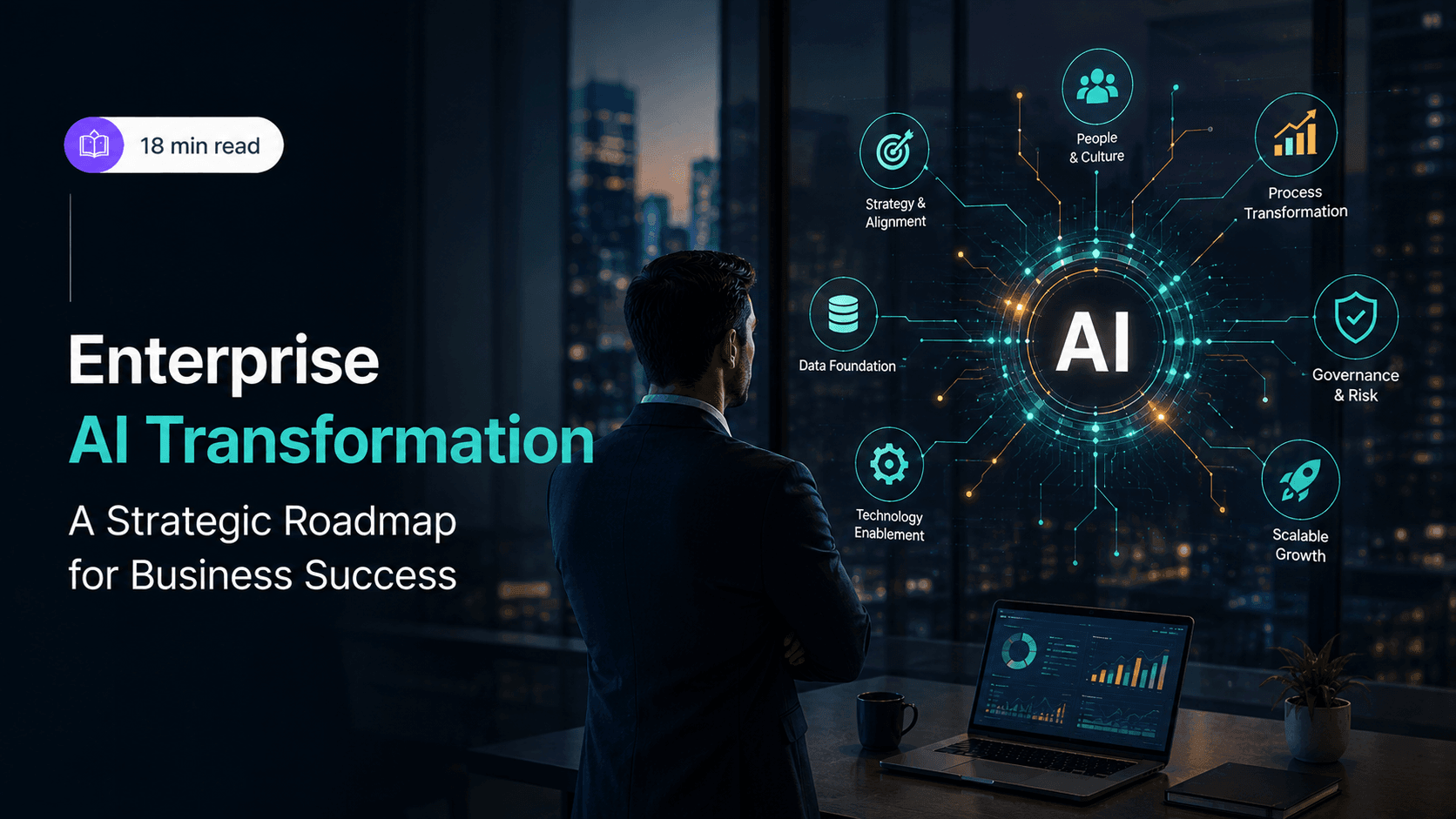
The Central Thesis: AI transformation is not model deployment. It is the design of workflows which are economically important around reusable data, AI systems, governance, integration and human judgement. When deploying and training AI using proprietary data, encoded ways of working and feedback loops improve with use. Enterprises get an AI system which is tailor made according to their use-cases.
Executive summary
Perimattic has been implementing enterprise AI platforms and systems for its customers and what we have seen is enterprise AI adoption has crossed the experimentation threshold, but enterprise-scale economic impact has not. According to McKinsey's reported that 88% of surveyed organizations are using AI in at least one business function in 2025, while only 7% said AI was fully scaled. Gartner reported that at least half of generative-AI projects had been abandoned after proof of concept by the end of 2025, citing poor data quality, inadequate risk controls, escalating costs and unclear business value.
That gap defines the management problem of enterprise AI in 2026. The winners in enterprise AI adoption will not be the organisations that launch the most copilots or run the most pilots. They will be the organisations that redesign high-value or high ROI workflows, connect AI to their data and systems using connectors, change deliveries based on their industries, control risk proportionately, change how people work and measure value with ROI.
This is also where the idea of proprietary enterprise intelligence becomes strategically useful for an enterprise. LLM Models, cloud infrastructure and prebuilt AI agents are increasingly accessible to everyone. So, what's the differentiation? and that shifts toward assets competitors cannot simply buy which is proprietary data, institutional knowledge encoded in workflows, domain-specific learnings, integrations using connectors, feedback loops and operating practices of an enterprise. That perspective checks out with the recent Bain thesis that competitive advantage will always come from combining unique data, distinctive ways of working and learning AI systems.
Board-level test: An organisation has moved from AI pilots to enterprise scale when AI is embedded in normal workflows, technology operations, data ownership, risk management, workforce practices and business planning and when its operational and financial outcomes can be measured.
of organizations are using AI in at least one business function.
Source: McKinsey (2025)
said AI was fully scaled across the enterprise.
Source: McKinsey (2025)
of GenAI projects abandoned after proof of concept.
Source: Gartner (2025)
of organisations are seeing productivity or efficiency gains from AI.
Source: Deloitte (2026)
report increased revenue from AI — efficiency leads, revenue lags.
Source: Deloitte (2026)
typical payback period for enterprise AI; only 6% see ROI within one year.
Source: Deloitte (2025)
Sources: McKinsey State of AI 2025; Gartner 2025; Deloitte State of AI in the Enterprise 2026.
1. What AI transformation actually means
AI transformation is the systematic redesign of an enterprise's existing products, services, workflows, decisions and the operating model around AI-enabled capabilities, supported by their reusable data, governance and workforce adoption. It is different from AI adoption. Subscribing to an enterprise copilot, enabling a chatbot or deploying a model can be useful, but none of those actions alone would change how the enterprise creates value.
The distinction matters because AI benefits are currently linked toward efficiency. Deloitte's 2026 State of AI in the Enterprise reports that 66% of organisations are seeing productivity or efficiency gains, 53% better insights and decision-making, and 40% cost reduction, while only 20% report increased revenue. AI Transformation begins when AI changes the economics of an end-to-end workflow or enables a new product, service or business model - not merely when it makes an existing task faster.
For all of our AI transformation implementations at Perimattic we suggest our customers to take the AI readiness assessment which can help and access across data, infrastructure, team capability, process maturity and governance if an organization is ready for transformation. For organisations that need a deeper diagnostic and implementation roadmap, Perimattic's AI Readiness Assessment service converts those gaps into a prioritised plan.
Five value pools for the business case
| Value pool | Enterprise examples | Primary measures |
|---|---|---|
| Revenue & growth | Personalisation, next-best action, AI-enabled products, sales assistance | Incremental revenue, conversion, retention, product revenue |
| Cost & productivity | Document processing, software engineering, finance operations, service automation | Cost per transaction, realised hours, throughput, capacity released |
| Customer & service | AI assistants, service routing, proactive resolution | CSAT/NPS, first-contact resolution, response time, abandonment |
| Risk & resilience | Fraud, anomaly detection, compliance review, cybersecurity | Loss avoided, false positives, incidents, control effectiveness |
| Strategic option value | New services, agentic processes, faster R&D | Time to market, innovation pipeline, new-product revenue |
The strongest programmes distinguish capacity created from cashable value. Cutting a 60-minute task to 30 minutes creates theoretical productivity, but it becomes financial value only when the released capacity is converted into more output, avoided hiring, lower contractor spend, faster revenue, improved quality or an actual cost reduction. McKinsey's 2026 measurement framework makes this connection explicit by linking technical performance and adoption to operational, strategic and financial outcomes.
What is the business case for enterprise AI transformation? The business case is to convert AI from a collection of productivity tools into a repeatable capability for increasing revenue, lowering unit costs, improving customer outcomes, reducing risk and creating new products. The management challenge is not access to models; it is workflow redesign, adoption, integration and measurable value realisation.
2. Why AI pilots stall — and what enterprise scale requires
In a pilot project the ask would be, "Can the technology do this?" At enterprise scale asks harder questions: Can it perform reliably on real data? Can it integrate into the operating workflow? Who owns the result? Can thousands of users adopt it? Can finance verify the benefits? Can risk teams control it? Can engineering update or roll it back safely? Can its economics survive production-level usage?
Gartner's 2026 analysis identified four recurring reasons projects die after proof of concept: data quality, risk controls, cost and unclear value. Those are the issues which a prototype or POC can postpone but production deployment cannot.
No Baseline Economics
The demo works, but there is no baseline KPI, business owner, benefit-attribution method or scale/stop threshold.
Curated Data Hides Reality
Real systems introduce missing fields, permissions, stale documents, inconsistent metadata and unstructured content.
Workflow Unchanged
The model is optimized during POC while the workflow remains as it is — faster old process, not a better one.
Integration Deferred
Authentication, APIs, event flows, write-back, records retention and observability become the real bottleneck.
Fragmented Stacks
Every team builds separate gateways, vector stores, prompt frameworks, model providers and controls — creating technical debt.
Governance as Afterthought
Governance treated as a final approval gate rather than part of the original design of the solution.
Source: Gartner 2025 — data quality, risk controls, escalating costs and unclear business value.
Perimattic's AI Integration Services focus on APIs, data pipelines, ERP/CRM connectors, security, deployment and observability - the core nervous system that turns a model into a business capability.
The five enterprise enablers
| Dimension | Capabilities required | Failure mode when absent |
|---|---|---|
| Organisation | Executive sponsorship; value office; accountable process owners; central platform + domain squads | Technology owns AI while business units do not own workflow change or benefits |
| Technology | Shared platform; model gateway; CI/CD; registries; evaluation; observability; rollback | Every pilot becomes a bespoke production system |
| Data | Named owners; quality SLAs; metadata; lineage; permissions; RAG/index lifecycle | Good models produce unreliable or inaccessible answers |
| Governance | AI inventory; risk tiers; impact assessment; evaluation; human oversight; incident routes | Governance either blocks everything or arrives too late |
| Culture & workforce | AI literacy; role training; workflow redesign; champions; incentives | Employees retain old processes, distrust tools or create shadow AI |
3. Architecture, MLOps and the production AI control plane
The technical jump that moves a pilot to enterprise AI is a technical shift of applications that calls a model to fully managed AI systems with an operational lifecycle. In production systems, it's no longer just a model that requires control it's more than that. In generative and agentic systems it can include model versions, prompts, tools, retrieval sources, embedding models, chunking strategies, safety policies, orchestration graphs and evaluation datasets.
Control Plane
Identity, security, policy, versioning, evaluation, observability, FinOps, audit and deployment — spanning all layers.
Standardise the rails, not every train. Centralise identity, security, data access, evaluation, deployment, observability, cost attribution and governance.
For RAG systems, retrieval infrastructure is part of the product, not plumbing. Perimattic's guide to choosing a vector database provides a practical framework around scale, deployment constraints, hybrid search, filtering, cost and exit risk.
Maturity sequence for production AI deployment
4. From generic AI to proprietary intelligence
The strategic question is no longer "Which model do we buy?" Models are improving quickly and access is broadly available. The more durable question is: What intelligence can our organisation create that competitors cannot reproduce simply by buying the same model?
The answer for that question usually sits in three assets: proprietary data, encoded workflows and learning architecture. Proprietary data captures customer, operational and outcome history. Encoded workflows capture the institutional judgement of how the company wins. Learning architecture closes the loop so human decisions, AI outputs and business outcomes improve the next iteration. This is the core idea behind Bain's recent "proprietary intelligence" thesis and a useful lens for enterprise AI strategy.
This shifts the build-versus-buy discussion. Buy commodity capability where speed and scale matter. Build or deeply configure the elements that encode competitive advantage: proprietary data products, workflow logic, domain-specific evaluation, integrations, orchestration, user experience and feedback loops. Perimattic's AI Development Services cover custom AI agents, RAG systems, machine-learning models and production MLOps for the parts of the stack that need to be tailored.
Build / buy / hybrid decision
| Strategy | Best when | Trade-off |
|---|---|---|
| Buy / managed | Capability is commodity; speed matters; vendor platform already owns the workflow | Less differentiation; vendor dependency; pricing and data constraints |
| Build | Workflow or model behaviour is strategically differentiated; sovereignty/control is critical | Higher engineering and operating burden |
| Hybrid | Commodity model + proprietary data, orchestration, evaluation, integrations and UX | More architecture discipline required, but often the best enterprise default |
For LLM behaviour, the same logic applies at a smaller scale. Perimattic's fine-tuning vs prompt engineering guide recommends starting with prompting and retrieval, then fine-tuning when behaviour is stable, high-volume and demonstrably constrained by prompting.
5. Economics: cost, ROI and the KPI stack
There is no honest single number for "enterprise AI cost." A document assistant, a company-wide copilot, a regulated decisioning platform and an autonomous multi-agent workflow will have different cost structures. The defensible approach is to model total cost of ownership (TCO) and then find actual production consumption.
The denominator should include model/API charges, licences, cloud or GPU use, retrieval and storage, data engineering, integration, evaluation, cybersecurity, risk/compliance review, platform engineering, vendor services, user support, change management, training and operational oversight.
For a first-pass business case, Perimattic's free AI ROI Calculator produces a three-year projection, sensitivity analysis, payback period and risk assessment. It should be treated as a scenario-planning tool; the production business case should be updated with real usage and benefit data as the pilot progresses.
Deloitte's 2025 ROI study found that most respondents reported satisfactory ROI on a typical AI use case within two to four years, while only 6% reported payback inside one year. The implication is not that every AI initiative should take years to pay back. It is that portfolio-level transformation and individual workflow automation have different ROI horizons, and leaders should avoid generic benchmark promises.
VALUE
ADOPTION
QUALITY
UNIT ECONOMICS
AI ROI = (incremental attributable benefit − fully loaded AI cost) / fully loaded AI cost
KPI layers for enterprise AI
| KPI layer | What to measure | Example scale gate |
|---|---|---|
| Financial | Revenue, realised savings, margin, cost-to-serve, TCO, payback | Business case remains above hurdle after actual production costs |
| Strategic/customer | Retention, CSAT/NPS, compliance, time-to-market | Target outcome improves without unacceptable secondary effects |
| Operational | Cycle time, throughput, rework, defects, FCR, cost per case | Material improvement versus baseline/control |
| Adoption/behaviour | Active users, workflow penetration, acceptance/override, automation rate | AI is part of normal work, not occasional experimentation |
| Technical/risk | Accuracy, groundedness, hallucinations, latency, drift, uptime, inference cost | Quality, reliability, risk and cost remain inside thresholds |
This five-layer logic closely follows McKinsey's value-measurement framework, which recommends defining value up front, building attribution into rollout and managing AI as an investment with recurring decision gates.
6. Governance should accelerate safe scaling, not become a final gate
An enterprise governance model should be risk-tiered. An internal brainstorming assistant bot of an enterprise should not face the same controls as a system making important employment, credit, healthcare or safety decisions. The goal is explicit ownership, documented risk tolerance, evidence-based evaluation, controlled release and rapid incident response.
The NIST AI Risk Management Framework provides a durable structure through its Govern, Map, Measure and Manage functions, with governance designed as a cross-cutting activity across the lifecycle. For organisations operating in the European Union, the regulatory context is now operational: the European Commission states that the AI Act became generally applicable on 2 August 2026, with staged exceptions and extended transition periods for some high-risk systems.
Governance also requires evidence from production. Traditional uptime monitoring cannot tell you that a fluent LLM response is wrong, ungrounded or becoming more expensive. Perimattic's LLM observability guide explains why hallucination, drift and retrieval health need their own monitoring layer. For implementation, AI Observability Services cover model performance, drift detection, explainability, alerts and experiment tracking.
For regulated enterprises that need tracing and compliance evidence, the Perimattic AI Suite is positioned around OpenTelemetry-native agent tracing, hallucination detection, LLM cost tracking and audit evidence.
Governance principle: The fastest governance is governance embedded in the delivery platform: approved patterns, risk tiers, evaluation gates, audit logs, versioning, human-oversight requirements and incident routes — not repeated manual reinvention for every project.
7. AI transformation is a workforce and operating-model transformation
A CIO can build a platform, but cannot independently change how sales sells, procurement sources, finance closes, customer service resolves or engineering ships. Domain leaders must own each agent workflow outcomes while technology, data and risk teams provide the reusable rails.
BCG's 10-20-70 heuristic: ~10% of value from algorithms, 20% from technology and data, 70% from people and process changes.
Workforce capability layers
- Universal AI literacy: Permitted use, data handling, verification, privacy, IP, cyber risks and escalation.
- Role-based proficiency: Training tailored to sales, finance, service, developers, analysts and other functions.
- Deep technical capability: Data engineering, AI platform engineering, evaluation, security and AI risk.
- Manager enablement: Redesign workloads, set expectations, decide where human judgement remains essential.
- Career redesign: If AI absorbs junior tasks, create new ways for employees to build judgement and domain expertise.
8. Scale by business domain, not by a random list of use cases
The optimum unit of transformation is usually the workflow or business domain. A procurement process, sales journey, finance close or customer-service operation can contain multiple models, agents and automations but should have one accountable business outcome.
| Function | High-value AI transformation themes | Illustrative outcome |
|---|---|---|
| Finance | Close automation, anomaly detection, forecasting, controls, decision support | Faster close, lower cost, better forecast accuracy |
| Sales | Research, lead prioritisation, proposal support, next-best action, AI sales agents | Higher conversion, shorter cycle, more seller capacity |
| Procurement | Spend intelligence, sourcing, supplier risk, contract review, autonomous workflows | Lower leakage, faster sourcing, better compliance |
| Customer service | Agent assist, routing, knowledge retrieval, voice agents, autonomous resolution | Higher FCR, lower handle time, lower cost-to-serve |
| HR | Recruiting, skills intelligence, employee service, workforce planning | Faster hiring, better mobility, lower admin load |
| IT & engineering | Coding, testing, incident response, AIOps, knowledge systems | Faster delivery, lower incident cost, improved reliability |
| Operations & supply chain | Forecasting, scheduling, predictive maintenance, quality, inventory | Higher throughput, lower downtime, lower working capital |
Where AI insights need to become actions inside operational systems, AI Automation Services provide a natural implementation bridge. For workflows that require agents to plan, call tools and complete multi-step tasks, Perimattic's AI Agent Development Services focuses on production-deployed autonomous agents with tool integrations and human handoffs.
9. A practical roadmap from pilot to enterprise scale
01
Prioritise
Business outcome, owner + KPI
02
Prove
Real data, quality + value
03
Productionise
Integrate, secure + observe
04
Scale
Reusable platform, domain rollout
05
Optimise
Cost + quality, portfolio learning
| Phase | Primary objective | Exit evidence |
|---|---|---|
| Weeks 0–6 | Set transformation thesis, select 3–5 value domains, baseline economics and risk | Named owners, portfolio priorities, baselines, initial architecture and governance |
| Weeks 6–12 | Prove 2–4 lighthouse workflows on real data | Measured quality, user pull, integration feasibility, credible TCO and value hypothesis |
| Months 3–6 | Productionise and instrument | CI/CD, evaluation gates, observability, security, adoption and attribution data |
| Months 6–12 | Build reusable platform, data products and governance | Shared gateways, reusable patterns, self-service onboarding, portfolio reviews |
| Months 12–24+ | Redesign domains and scale portfolio | Sustained adoption, improved operational KPIs, measurable financial outcomes |
Pilot-to-Production Checklist
A named business/process owner is accountable for the outcome, not merely model delivery.
A measurable pre-AI baseline, target and benefit formula exist, with a credible attribution method.
A stop/scale rule defines the quality, adoption, value and risk thresholds for additional investment.
Production data has named owners, permissions, quality controls, metadata and lineage.
The AI system has a risk tier, evaluation criteria, appropriate human oversight and an incident route.
Models, prompts, retrieval assets and code are versioned; releases pass automated evaluation.
Deployment supports controlled rollout and rollback; observability covers quality, latency, failures, drift and cost.
TCO includes data, integration, security, compliance, evaluation, change, support and operational oversight.
Users and managers have role-specific training and redesigned working practices.
Vendor contracts cover data usage, IP, security, residency, model changes, auditability and exit/portability.
The implementation reuses enterprise platform capabilities rather than creating one-off infrastructure.
A recurring portfolio review reallocates funding away from low-value experiments toward verified workflows.
10. Where to start
For most enterprises, the first step is not another technology shortlist. It is a quantified view of where AI can create value and whether the organisation is ready to deliver it. Start with three questions: Which workflows matter economically? What proprietary data and institutional knowledge make those workflows distinctive? What capabilities are missing between a working prototype and reliable production?
Practical next step: Use the free Perimattic AI Readiness Assessment to identify gaps, then model the economics with the AI ROI Calculator. If the opportunity survives those two tests, move into a focused strategy/integration engagement with a named business owner, real production data and explicit scale/stop criteria.