


If you have spent any time building with large language models, you have probably asked yourself the same question a hundred times: should I fine-tune this model, or should I just write a better prompt.
It is not an academic question. It is a budget question, a timeline question, and often a "will this project survive contact with production" question. Teams routinely burn weeks fine-tuning a model that a well-structured prompt would have solved in an afternoon. Other teams spend months stacking prompt instructions on top of few-shot examples on top of retrieval, trying to force a base model to behave like something it was never trained to be.
This post is not another "fine-tuning vs prompting" explainer that ends with "it depends." It does depend, but the factors it depends on are specific and testable. Below, we walk through what each approach actually does to a model, where each one wins, where each one quietly fails, and how to make the call without guessing.
What Prompt Engineering Actually Does
Prompt engineering is the practice of shaping a model's output by controlling its input, without changing any of the model's underlying weights. You are not teaching the model anything new. You are giving it better instructions, better context, and better examples so it can retrieve and apply knowledge it already has.
This includes:
- Zero-shot and few-shot prompting, where you show the model examples of the input-output pattern you want
- Chain-of-thought prompting, where you ask the model to reason step by step before answering
- System prompts that define role, tone, and constraints
- Retrieval-augmented generation (RAG), where you inject relevant documents into the context window at query time
- Structured output prompting, where you constrain the model to JSON, XML, or a specific schema
The key thing to understand is that prompt engineering works within the model's existing capability. If the model has never seen anything resembling your task in its training data, no amount of clever prompting will conjure that capability out of nothing. Prompting is retrieval and steering, not education.
What Fine-Tuning Actually Does
Fine-tuning changes the model itself. You take a pretrained model and continue training it on a smaller, task-specific dataset, updating its weights so the new behavior becomes baked in rather than requested each time.
There are a few common flavors:
- Full fine-tuning, where every parameter in the model is updated (expensive, rarely necessary anymore)
- Parameter-efficient fine-tuning (PEFT) methods like LoRA and QLoRA, where you train a small set of additional parameters while freezing the base model, cutting compute cost dramatically
- Instruction fine-tuning, where you train the model on examples of instructions and correct responses to make it more reliably follow a specific format or behavior
- Preference fine-tuning (RLHF, DPO), where the model is trained to prefer certain kinds of outputs over others based on human or AI feedback
Once fine-tuned, the model does not need to be told the pattern every time. It has internalized it. This is the fundamental trade-off: prompting asks the model to do something, fine-tuning changes what the model is.
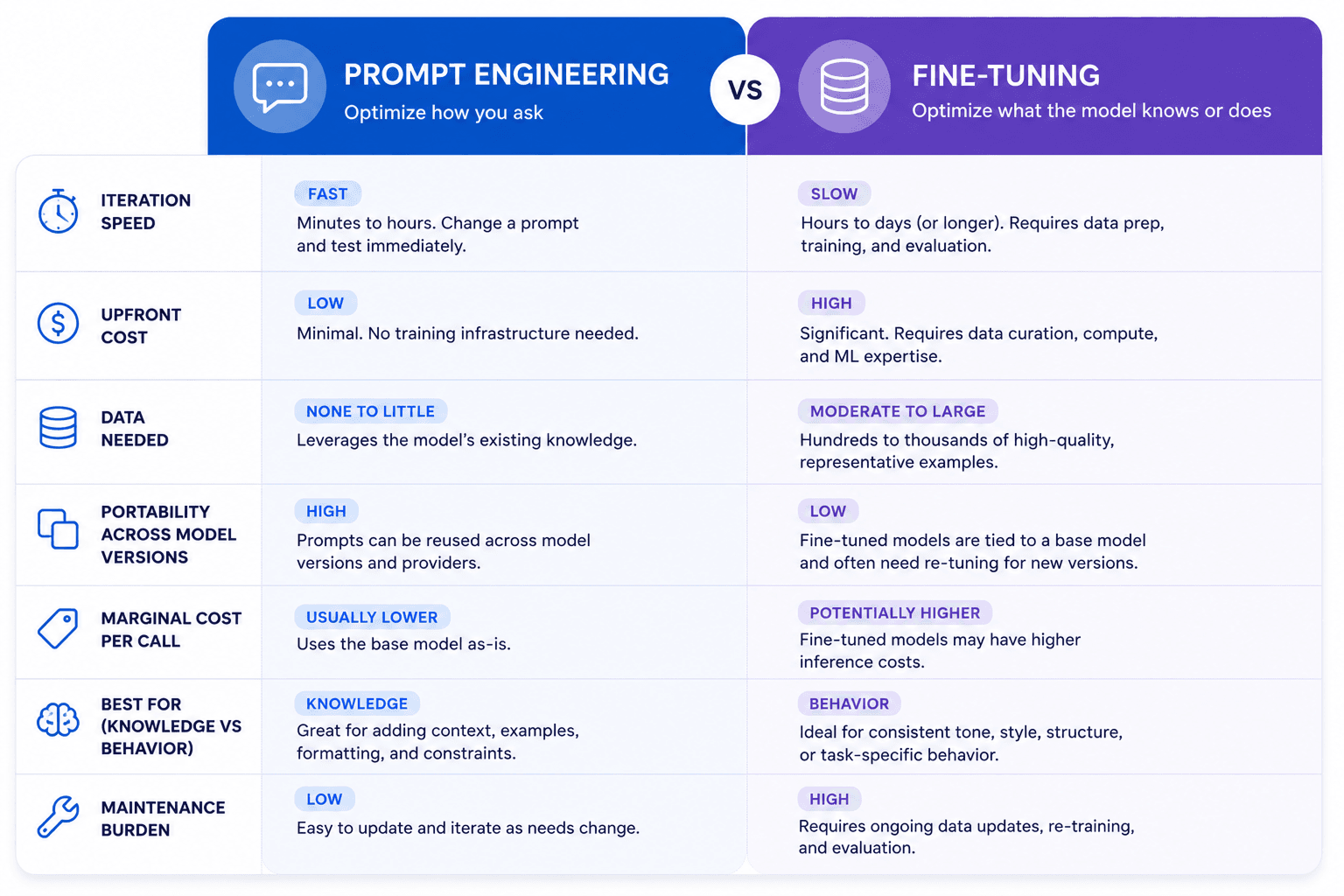
The Core Difference That Decides Everything
Here is the single question that resolves most fine-tuning vs prompting debates: are you trying to change what the model knows, or how it behaves when it already knows enough.
If your problem is "the model does not have access to the information it needs," fine-tuning will not fix that reliably. Fine-tuning is a poor way to inject facts, because the model can easily memorize training examples without generalizing the underlying knowledge, and it has no built-in mechanism for staying current as facts change. Retrieval-augmented generation, a prompting technique, is almost always the better fit here.
If your problem is "the model knows enough but consistently gets the format, tone, reasoning style, or edge-case handling wrong," fine-tuning is often the more durable fix, especially at scale, because it removes the need to re-explain the same behavior in every single prompt.
When Prompt Engineering Actually Wins
You are early in the project and still learning what "good" looks like. Prompting iterates in seconds. Fine-tuning iterates in hours or days, because you need a dataset, a training run, and an evaluation pass before you know if the change helped. If your task definition is still moving, prompting lets you explore the problem space without locking in an expensive training cycle.
The task depends on information that changes. Customer support answers based on a knowledge base, pricing that updates weekly, product specs, current events, internal policy documents. Anything time-sensitive belongs in a retrieval pipeline, not baked into model weights. A fine-tuned model with stale facts is quietly wrong in a way that is hard to detect, because it answers confidently either way.
You need to support many different behaviors from one model. A single well-designed system prompt (or a small library of prompts) can switch a general-purpose model between dozens of tasks. Fine-tuning a separate model, or even a separate LoRA adapter, for every task multiplies your operational overhead: more artifacts to version, evaluate, and monitor.
Your data volume is small. Fine-tuning needs a reasonably sized, high-quality dataset to actually shift behavior without overfitting. If you have 40 examples of the pattern you want, few-shot prompting will likely outperform a fine-tune built on the same 40 examples, because the base model's general reasoning ability is still doing most of the work.
You are using a frontier hosted model and want to keep using it. If your product depends on a proprietary model's general reasoning quality, and that provider ships a materially better model every few months, fine-tuning locks you into whatever checkpoint you trained against. Prompting keeps you portable, since a good prompt usually transfers (with minor tuning) to the next model version.
Cost and latency of training are not worth it yet. If prompting gets you to 90 percent of your target quality bar, ask honestly whether the last 10 percent is worth a training pipeline, a labeled dataset, and ongoing retraining costs. Often it is not, at least not yet.
When Fine-Tuning Actually Wins
You need consistent behavior at scale, and prompting has hit a ceiling. If you are stacking longer and longer instructions into your system prompt, adding more few-shot examples, and still seeing inconsistent output on 5 to 10 percent of cases, that is usually a sign the model needs the behavior trained in rather than requested. Long, over-engineered prompts also become expensive: every token in the prompt is a token you pay for and a token that eats into your context budget, on every single call.
You need a specific output format or style with near-perfect reliability. Structured extraction into a rigid schema, a very particular brand voice used across thousands of generations a day, domain-specific terminology used consistently. Fine-tuning makes this the model's default behavior instead of something it has to be reminded of, which matters when you are generating at high volume and cannot manually review every output.
Latency and cost matter at your scale. A shorter prompt against a fine-tuned model is cheaper per call than a long, heavily-engineered prompt against a base model, especially once you multiply by millions of requests. Fine-tuning trades an upfront training cost for a lower marginal cost per inference.
You need the model to reliably do something it does poorly out of the box. Certain narrow domains (legal document classification, medical coding, proprietary internal taxonomies, low-resource languages) are underrepresented in general pretraining data. No amount of prompting will make a model good at a task it fundamentally lacks exposure to. If you have enough labeled examples, fine-tuning can close that gap directly.
You want to bake in safety or behavior constraints that must not be prompt-injected away. A system prompt can, in some cases, be overridden or leaked by a sufficiently adversarial user input. Behavior trained into the model's weights is harder to strip out with a clever prompt, which matters for guardrails you cannot afford to have bypassed.
You are trying to reduce your prompt-engineering maintenance burden. If your team is spending real engineering time babysitting a fragile prompt that breaks every time the underlying model updates, a fine-tune, especially a smaller open-weight model fine-tuned for your specific task, can be more stable and cheaper to maintain long-term than a brittle prompt on a moving-target hosted model.
A Practical Decision Framework
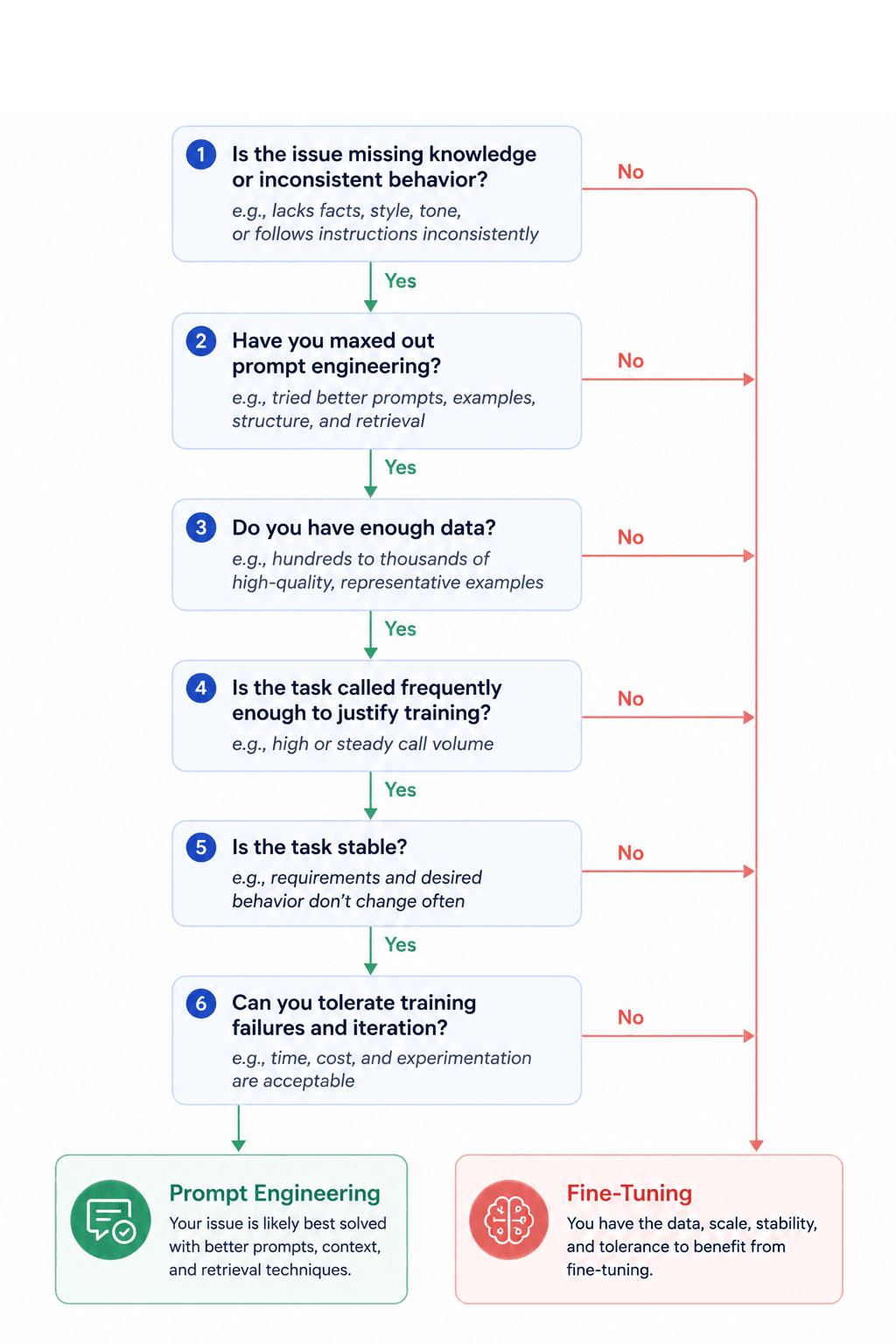
Rather than treating this as a binary choice, run through these questions in order.
- Is the problem missing knowledge or inconsistent behavior? Missing knowledge points to RAG. Inconsistent behavior points toward fine-tuning, once prompting has been genuinely exhausted.
- Have you actually maxed out prompting first? Most teams reach for fine-tuning before they have tried structured few-shot examples, better system prompts, and output constraints. Fine-tuning should usually be the second move, not the first.
- Do you have enough quality data? As a rough floor, most useful fine-tunes need at least a few hundred high-quality, representative examples, and PEFT methods can work with less than full fine-tuning would need. Below that, invest in prompting instead.
- What is your call volume? Low volume, exploratory, or highly variable tasks favor prompting. High volume, repetitive, well-defined tasks favor fine-tuning, because the training cost amortizes over more calls.
- How often does the underlying task change? Fast-changing tasks favor prompting, because you can update a prompt in minutes. Stable, well-understood tasks favor fine-tuning, because the investment pays off over a longer stable period.
- What is your tolerance for occasional failure? If the task is high-stakes and edge-case failures are expensive, fine-tuning combined with strict evaluation gates often provides more reliable guardrails than prompting alone.
The Combination Nobody Talks About Enough
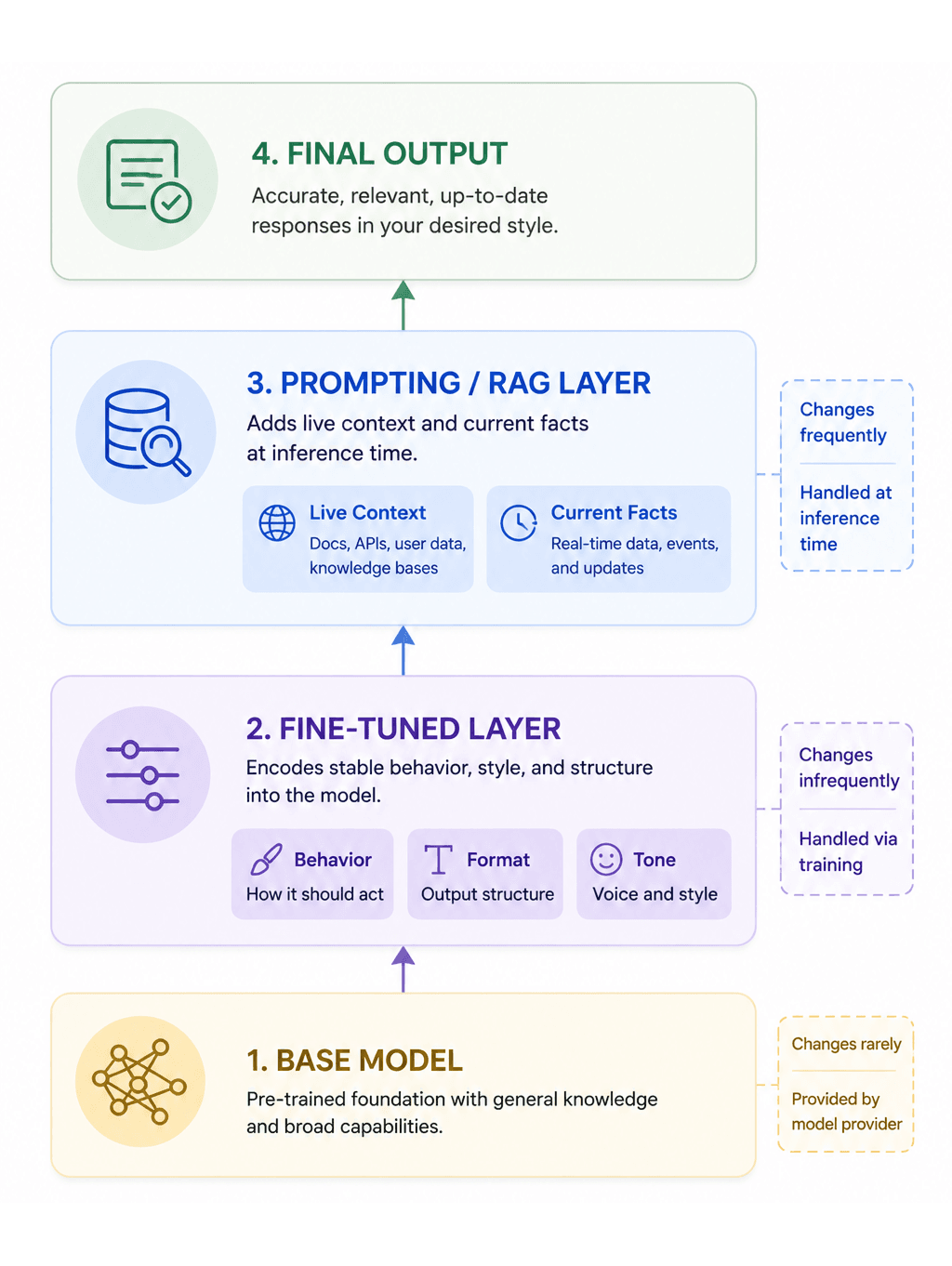
In practice, the best production systems rarely pick one and stop. A common and effective pattern looks like this: fine-tune the model on the core task behavior, format, and domain style, and use prompting and retrieval on top of that fine-tuned model to inject current, task-specific context at inference time.
This gets you the reliability and lower marginal cost of a fine-tuned model, combined with the flexibility and freshness of prompting and retrieval. Fine-tuning handles "how the model behaves." Prompting and RAG handle "what the model knows right now." Treating them as competing strategies rather than complementary layers is one of the more common strategic mistakes in LLM application design.
What This Looks Like in Practice
A support ticket triage system that needs to output a consistent JSON schema, in a consistent tone, thousands of times a day, is a strong fine-tuning candidate, especially once prompting has proven the concept and stabilized the desired behavior.
A research assistant that needs to answer questions about documents uploaded five minutes ago has no business being fine-tuned on those documents. That is a retrieval problem, solved with prompting.
A coding assistant that needs to follow a company's specific internal style guide, use internal library names correctly, and avoid deprecated internal APIs might benefit from fine-tuning once the pattern is well understood, but starts life as a system prompt with a few strong examples.
A chatbot answering questions about a product catalog that changes weekly should almost never be fine-tuned on that catalog. Fine-tune the conversational behavior and tone if needed, and retrieve the current catalog data at query time.
The Bottom Line
Prompt engineering wins when you need speed, flexibility, freshness, and low upfront cost, and it should be the default starting point for nearly every new LLM task. Fine-tuning wins when prompting has hit a real, measured ceiling, your task is stable and high volume, and the cost of ongoing prompt maintenance and inference tokens outweighs the cost of a training run.
The teams that get this right treat it as a sequence, not a fork in the road. Start with prompting. Instrument your failures. Once you know exactly where and why prompting breaks down, and you have the data to prove it, that is the moment fine-tuning earns its cost. Skipping straight to fine-tuning without that evidence is how teams end up with an expensive, brittle model that solves a problem they never fully defined.