


Key Takeaways
- Define success before evaluating the model. Set clear quality, accuracy, safety, latency, and cost requirements based on the specific use case.
- Evaluate the complete AI application, not just the LLM. For RAG and AI applications, test prompts, retrieval, context, guardrails, integrations, and model outputs together.
- Use realistic and adversarial test data. Include common user queries, edge cases, ambiguous inputs, long contexts, and prompts designed to expose safety vulnerabilities.
- Combine automated evaluation with human judgment. Automated metrics provide scale, while human reviewers are essential for assessing nuance, relevance, tone, and safety.
- Measure more than accuracy. Track metrics such as faithfulness, relevance, consistency, toxicity, latency, and cost per query to understand production readiness.
- Test under production-like conditions. Evaluate the model with realistic traffic, input lengths, retrieval pipelines, concurrency, latency requirements, and expected workloads.
- Investigate failure patterns, not just aggregate scores. A high overall evaluation score can hide serious weaknesses in specific user scenarios or domains.
AI Model Monitoring Services
Evaluation before launch is step one. We set up the production checks that keep evaluating your LLM once real users arrive.
There is a moment that almost every AI team hits eventually. The demo works beautifully. Leadership is impressed. Everyone wants to ship it. And then someone asks the question that should have come much earlier: how do we know this model is good enough for real users.
That question is harder to answer than it looks. LLMs do not fail the way traditional software fails. There is rarely a stack trace pointing you to the problem. Instead, a model might hallucinate a fact, misread a nuance, produce a subtly biased answer, or quietly drift into behavior nobody tested for. None of that shows up in a quick manual demo. It shows up three weeks after launch, in a support ticket, or worse, in a screenshot circulating online.
This is why LLM evaluation has become its own discipline, with its own tools, metrics, and best practices. If you are getting ready to move a model into production, here is a practical, thorough way to think about evaluating it first.
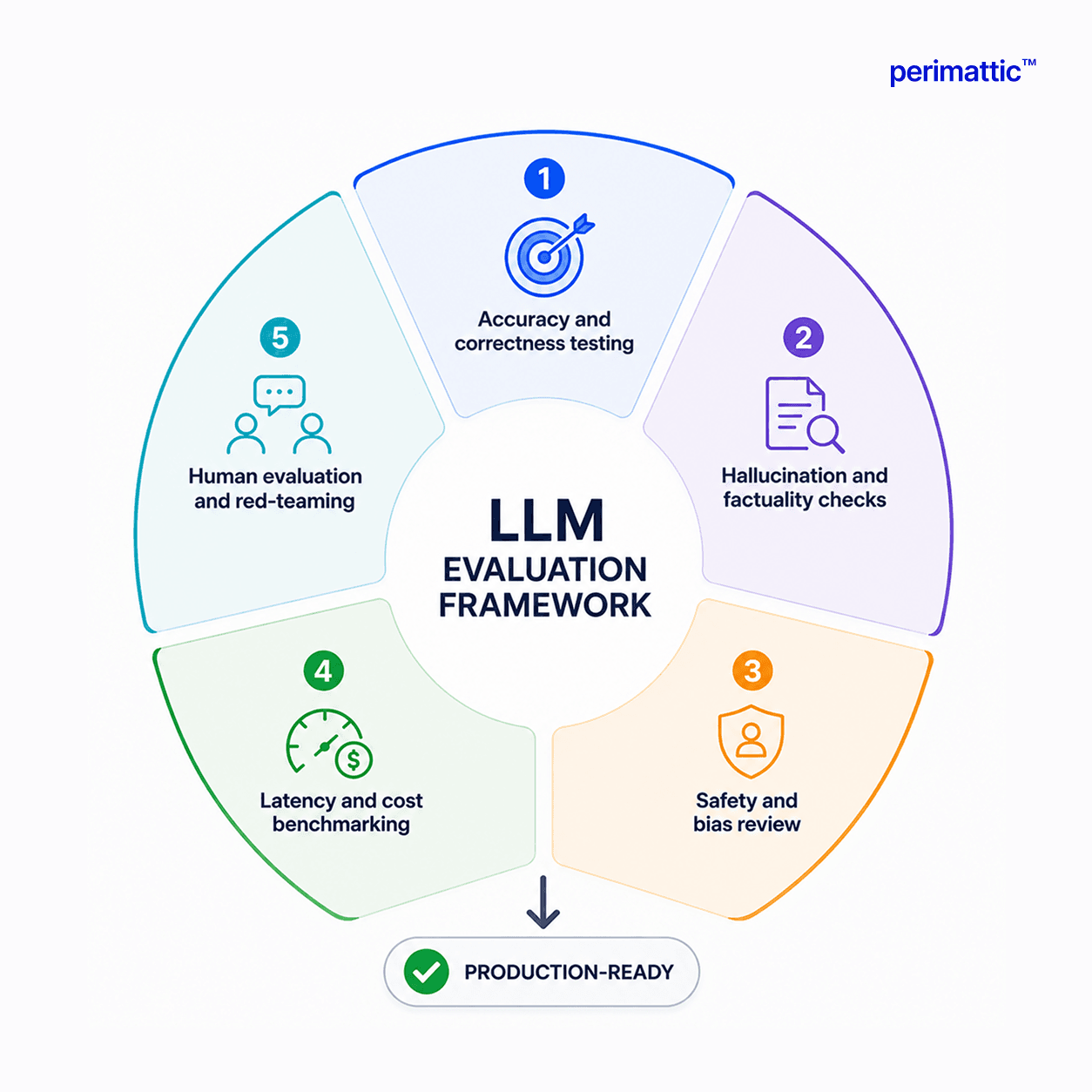
Why Evaluation Cannot Be an Afterthought
Traditional software testing checks whether code does what it is supposed to do. LLM evaluation is different because the same input does not always produce the same output, and "correct" is often a matter of degree rather than a clean pass or fail.
Skipping proper evaluation tends to create three kinds of problems down the line.
- Quality problems, where the model gives wrong, inconsistent, or low quality answers that erode user trust
- Safety problems, where the model produces harmful, biased, or inappropriate content that creates real reputational and legal risk
- Cost and performance problems, where a model that looked fine in testing turns out to be too slow or too expensive once real traffic hits it
Catching these issues before launch is dramatically cheaper, in both money and reputation, than catching them after.
Offline Evaluation vs Online Evaluation
Most evaluation strategies split into two broad categories, and a solid production process needs both.
| Type | When It Happens | What It Tells You | Example Methods |
|---|---|---|---|
| Offline evaluation | Before deployment, using curated test sets. | How the model performs on known scenarios. | Benchmark datasets, human review, and automated scoring. |
| Online evaluation | After deployment, using live traffic. | How the model performs with real and unpredictable users. | A/B testing, user feedback, and live monitoring dashboards. |
Offline evaluation is your safety net before launch. Online evaluation is your early warning system after launch. Teams that only do one or the other are flying partially blind. Offline testing alone cannot anticipate every real-world query, and online testing alone means you are essentially testing in production on real users, which is a risky place to discover a serious problem.
Core Metrics Worth Tracking
Not every metric matters equally for every application, so pick the ones that map to how your model is being used. Here is a breakdown of the most common categories.
| Metric Category | What It Measures | Good For |
|---|---|---|
| Accuracy / correctness | Whether factual claims and answers are actually correct. | Q&A systems, RAG applications, and customer support. |
| Relevance | Whether the response directly addresses the user's question. | Search, chatbots, and summarization. |
| Coherence and fluency | Whether the output reads naturally and follows a logical flow. | Content generation and drafting tools. |
| Faithfulness / groundedness | Whether the model stays aligned with the provided source material instead of inventing information. | RAG systems and document Q&A. |
| Toxicity and bias | Whether outputs contain harmful, offensive, or unfairly biased content. | Any user-facing application. |
| Latency | How long it takes to generate a response. | Real-time chat and voice assistants. |
| Cost per query | How much each response costs to generate. | High-volume applications and budget planning. |
| Consistency | Whether similar inputs produce similarly reasonable outputs. | Any application operating at scale. |
Most teams do not need to track every single one of these obsessively. Instead, pick the three or four that most directly reflect whether your application is doing its job well, and build your evaluation process around those.
A Practical Step-by-Step Evaluation Process
Here is a workflow that works well for most teams preparing to move a model into production.
Step 1: Define what "good" means for your use case
Before you can measure anything, you need a clear definition of success. A customer support bot needs to be accurate and polite. A code generation tool needs to be correct and safe to execute. A creative writing assistant needs to be engaging and coherent. Write these criteria down explicitly, because vague goals lead to vague evaluations.
Step 2: Build a representative test set
Gather real or realistic examples of what users will ask, not just easy, cherry-picked prompts. Good test sets include:
- Common, everyday queries your users will send constantly
- Edge cases and unusual phrasing that might trip the model up
- Adversarial prompts designed to test safety boundaries
- Ambiguous questions where the "correct" answer is genuinely debatable
Step 3: Choose your evaluation methods
You generally have three approaches, and most serious evaluation pipelines use a mix of all three.
- Automated metrics, using scoring functions, embedding similarity, or another LLM acting as a judge to score outputs at scale
- Human evaluation, where real reviewers rate outputs for quality, safety, and correctness, which is slower but catches nuance that automated scoring often misses
- Structured testing frameworks, using open source or commercial LLM evaluation tools that combine automated scoring, dataset management, and reporting in one place
Step 4: Run the evaluation and analyze failure patterns
Do not just look at an aggregate score and call it done. Dig into where and why the model fails. Is it struggling with a particular topic. Does performance drop on longer inputs. Does it hallucinate more when the source documents are ambiguous. These patterns tell you what to fix before launch, not just whether something is broadly wrong.
Step 5: Test under production-like conditions
A model that performs well on a clean test set in a notebook can behave very differently once it is wired into your actual application, with your actual prompts, your actual retrieval pipeline, and your actual latency constraints. Test the full pipeline, not just the model in isolation.
Step 6: Set up continuous monitoring for after launch
Evaluation does not stop once you ship. User behavior shifts, source documents change, and models themselves get updated by their providers. Set up ongoing monitoring so you catch quality drift early rather than discovering it through user complaints.
Common LLM Evaluation Tools
The evaluation tooling space has grown quickly, and different tools tend to specialize in different parts of the process.
| Tool Type | What It Typically Offers | Good Fit For |
|---|---|---|
| Evaluation frameworks | Structured scoring, dataset management, and automated metrics. | Teams building repeatable evaluation pipelines. |
| LLM-as-judge platforms | Using a strong model to score outputs against predefined criteria at scale. | Teams that need fast and scalable quality checks. |
| Human-in-the-loop platforms | Workflow tools for collecting structured human feedback. | High-stakes applications that require nuanced human judgment. |
| Observability and monitoring tools | Real-time tracking of production outputs, latency, and cost. | Ongoing post-launch monitoring. |
| Red-teaming and safety tools | Adversarial testing designed to identify harmful or unsafe outputs. | Safety-critical or public-facing applications. |
Rather than chasing the single "best" tool, most mature teams end up combining two or three, one for structured offline testing, one for human review, and one for live production monitoring.
Common Mistakes Teams Make
- Testing only on easy, well-behaved prompts instead of realistic and adversarial ones
- Relying purely on automated scores without any human review, missing subtle quality issues
- Evaluating the model in isolation instead of testing the full application pipeline, including retrieval and prompt templates
- Treating evaluation as a one-time gate before launch instead of an ongoing process
- Ignoring cost and latency until after the model is already in production and the bill arrives
- Failing to test for bias and harmful outputs simply because the demo never happened to surface them
Final Thoughts
Deploying a language model without a real evaluation process is a bit like shipping code without tests, except the failure modes are less predictable and often more visible to your users. The good news is that building a solid evaluation process does not have to be overwhelming. Start with a clear definition of what success looks like for your specific use case, build a realistic test set, combine automated and human review, and keep watching closely after launch.
Do this well, and you move from hoping your model works to actually knowing it does, with evidence to back it up. That confidence is worth every hour you put into getting evaluation right.