


Key Takeaways
- Full fine-tuning updates every model parameter and provides the most complete adaptation, but requires significantly more GPU memory and compute.
- LoRA freezes the pretrained model and trains small low-rank adapter matrices, substantially reducing the number of trainable parameters and memory requirements.
- QLoRA combines LoRA with 4-bit quantization, reducing memory requirements further and making fine-tuning larger models possible on more limited hardware.
- LoRA is generally a strong default for enterprise fine-tuning, while QLoRA is particularly useful when model size or available GPU memory makes standard LoRA difficult.
- The choice should consider adaptation requirements, available hardware, dataset quality, and overall project cost, rather than assuming one technique is universally better.
- Fine-tuning methods do not replace rigorous evaluation. Models should be tested against validation data that reflects real production use.
- LoRA and QLoRA adapters can remain separate from the base model, allowing multiple fine-tuned versions to be served from a single base deployment.
- Data quality matters more than simply increasing dataset size, with the QLoRA research emphasizing the value of smaller, high-quality instruction datasets.
- LoRA and QLoRA can significantly reduce GPU and cloud infrastructure costs, but teams should evaluate the full lifecycle cost, including inference, monitoring, and retraining.
LLM Fine-Tuning Services
Choosing between LoRA, QLoRA, and full fine-tuning is only half the problem — our team scopes the right approach for your model, data, and budget, then ships it to production.
Fine-tuning a large language model used to mean one thing: updating every single parameter in the model using your own data, a process that requires enormous GPU memory and a budget to match. That's still an option, and sometimes the right one. But two other approaches, LoRA and QLoRA, have become the default starting point for most teams, because they get most of the benefit of fine-tuning at a fraction of the compute cost. This guide breaks down how each approach works, what the original research shows about the tradeoffs, and how to decide which one fits a given project.
Full Fine-Tuning: The Baseline
Full fine-tuning updates every parameter in a pretrained model using new, task-specific data. It's the most direct approach, and it produces the model that's had the most complete opportunity to adapt to a new task or domain, since nothing about the original weights is frozen or constrained.
The cost is significant. Full fine-tuning requires storing gradients and optimizer states for every parameter in the model, which for a modern large language model means GPU memory requirements that scale directly with model size. Fine-tuning a model in the tens of billions of parameters with full fine-tuning typically requires multiple high-end GPUs working together, and that hardware requirement is the main reason most teams look for alternatives before defaulting to this approach.
LoRA: Low-Rank Adaptation
LoRA, introduced in the paper "LoRA: Low-Rank Adaptation of Large Language Models" by Hu et al., takes a fundamentally different approach. Instead of updating all of a model's original weights, LoRA freezes the pretrained model entirely and injects small, trainable low-rank matrices into specific layers, typically the attention layers. Only these new, much smaller matrices get trained. The original model weights never change.
This works because of an insight the paper's authors formalized: the weight updates needed to adapt a large pretrained model to a new task tend to have a low "intrinsic rank," meaning the actual useful information in that update can be captured by a much smaller set of parameters than the full weight matrix. By training only these low-rank adapter matrices, LoRA reduces the number of trainable parameters dramatically, and because gradients and optimizer states only need to be tracked for the small adapter matrices rather than the full model, memory requirements drop correspondingly.
QLoRA: Quantized LoRA
QLoRA, introduced in Dettmers et al.'s 2023 paper, pushes this idea further by combining LoRA with quantization. Instead of keeping the frozen base model in full 16-bit precision, QLoRA quantizes it down to 4-bit precision using a new data type the authors call 4-bit NormalFloat (NF4), specifically designed to represent the normally-distributed weight values found in trained neural networks with minimal information loss. Gradients are then backpropagated through this frozen, 4-bit quantized model into the same kind of trainable LoRA adapters.
The paper's headline result is striking: QLoRA made it possible to fine-tune a 65-billion-parameter model on a single 48GB GPU while preserving the full performance of 16-bit fine-tuning, a scale of model that would otherwise require far more hardware. The authors also introduced double quantization, which quantizes the quantization constants themselves, saving roughly an additional 0.37 bits per parameter (about 3GB of memory for a 65B model), and paged optimizers, which use NVIDIA's unified memory to prevent out-of-memory crashes during memory usage spikes. Using this method, the authors trained a model family called Guanaco, which reached 99.3% of ChatGPT's performance level on the Vicuna benchmark after just 24 hours of fine-tuning on a single GPU.
Benchmark Comparison
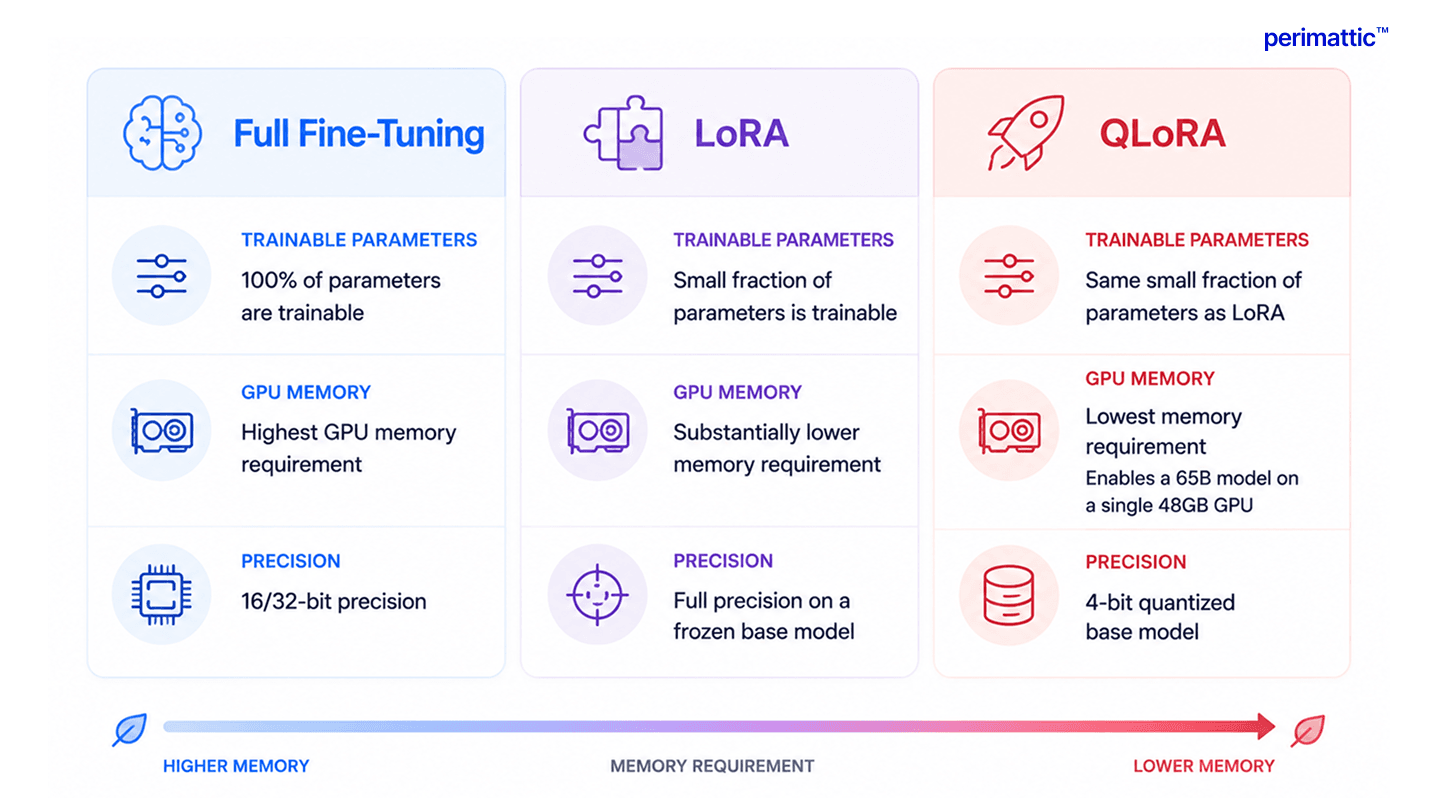
| Approach | Trainable Parameters | Typical GPU Memory Need | Base Model Precision | Key Innovation |
|---|---|---|---|---|
| Full fine-tuning | 100% of model parameters. | Highest, scales directly with model size. | Full precision (16 or 32-bit). | None, direct gradient updates to all weights. |
| LoRA | Small fraction, via low-rank adapter matrices. | Substantially lower than full fine-tuning. | Full precision (base model frozen). | Low-rank decomposition of weight updates. |
| QLoRA | Same small fraction as LoRA. | Lowest of the three, enabling larger models on limited hardware. | 4-bit quantized (base model frozen). | 4-bit NormalFloat quantization, double quantization, and paged optimizers. |
The core tradeoff across all three sits on a spectrum: full fine-tuning offers the most complete adaptation at the highest hardware cost, LoRA offers most of that adaptation quality at a fraction of the memory cost, and QLoRA pushes memory requirements down further still by additionally quantizing the frozen base model, based on the original papers' own reported results rather than a generic industry claim.
When to Use Each Approach
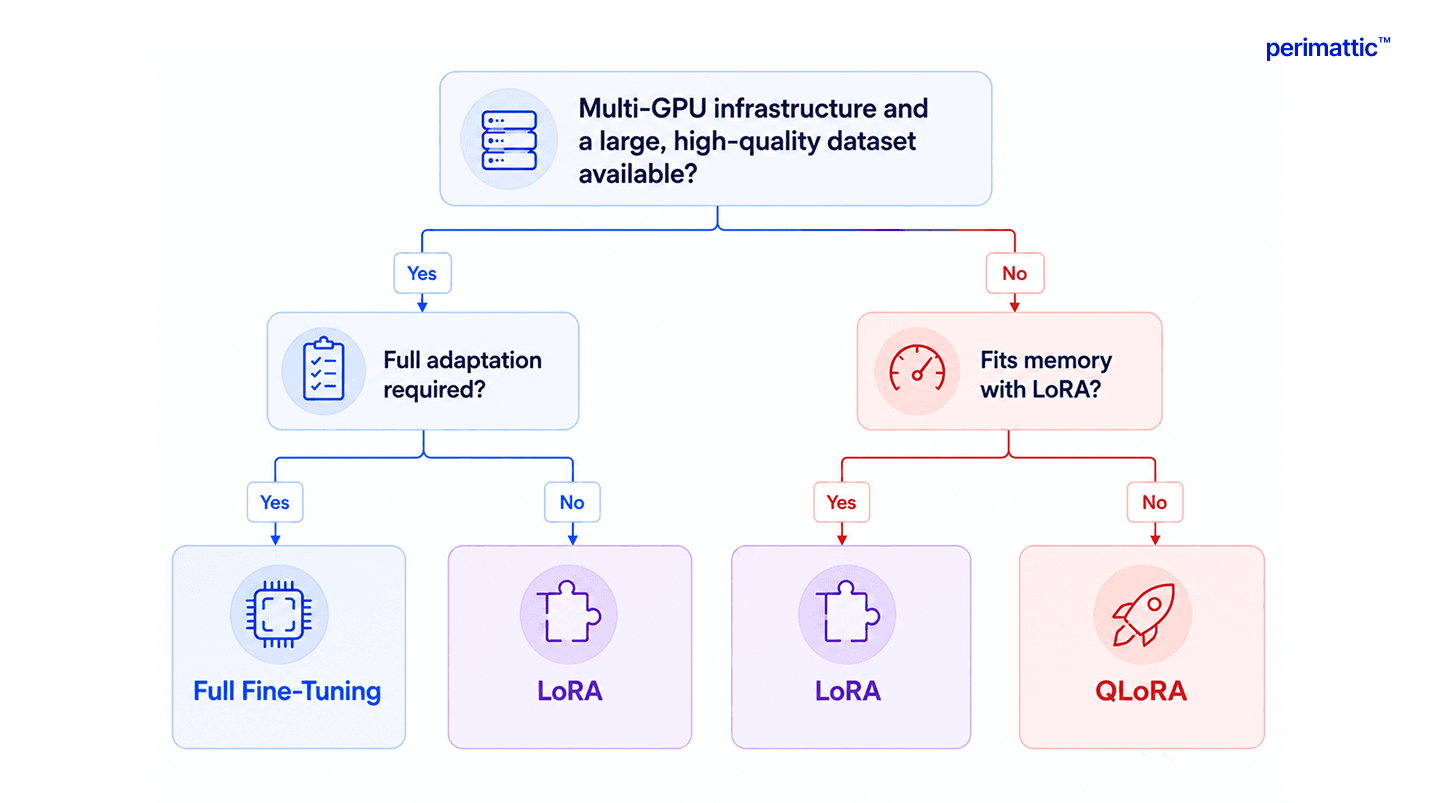
Full fine-tuning makes sense when the task requires substantial behavioral change from the base model, when there's a large, high-quality dataset available, and when the compute budget genuinely isn't a constraint, most commonly inside organizations training foundation models themselves rather than adapting an existing one.
LoRA is the right default for most enterprise fine-tuning projects: adapting an existing pretrained model to a specific domain or task, on hardware that doesn't require a full multi-GPU cluster, while keeping the ability to swap between different task-specific adapters on top of the same frozen base model.
QLoRA is the right choice when the model being fine-tuned is large enough that even LoRA's reduced memory footprint doesn't fit the available hardware, or when cost-efficient fine-tuning on a single GPU or a smaller cloud instance is a priority. Its main tradeoff versus standard LoRA is the added complexity of quantization and, depending on the specific implementation, potentially somewhat slower training throughput in exchange for the lower memory footprint.
Decision Framework
Practical Considerations Beyond the Headline Numbers
Inference doesn't have to carry the training-time savings forward automatically. LoRA and QLoRA adapters can be merged back into the base model weights after training, or kept separate and applied at inference time. Keeping adapters separate allows serving multiple fine-tuned "versions" from a single base model deployment, which is a meaningful architectural advantage for teams supporting several fine-tuned use cases, but it does add a small amount of inference-time overhead compared to a fully merged model.
**Data quality still matters more than the fine-tuning method. ** The QLoRA paper's own findings emphasized that a small, high-quality instruction dataset produced better results than simply having more data of lower quality. Choosing between LoRA and QLoRA doesn't substitute for the more fundamental work of curating a clean, representative fine-tuning dataset.
**None of these techniques replace a well-designed evaluation process. ** Whichever fine-tuning approach is used, the resulting model still needs rigorous evaluation against a validation set that reflects real production use, the same evaluation discipline that any MLOps practice treats as a required pipeline stage rather than an optional check at the end.
Building This Into a Production Workflow
Fine-tuning a model is rarely the finish line. The resulting model still needs to be deployed, monitored for drift and degraded output quality over time, and potentially retrained as new data becomes available, the same operational discipline covered under custom LLM development services, where fine-tuning is one stage in a larger production lifecycle rather than a standalone project. Teams that treat fine-tuning as a one-time event, rather than the start of an ongoing model lifecycle, tend to see the same kind of silent quality degradation over time that affects any production machine learning system without active monitoring in place.
Choosing LoRA's Rank and Target Layers
LoRA's key hyperparameter is rank, the size of the low-rank matrices being trained, and it directly trades off adaptation capacity against parameter count. A lower rank means fewer trainable parameters and faster, cheaper training, but potentially less capacity to capture a complex new task. A higher rank increases capacity at the cost of some of the memory savings that make LoRA attractive in the first place. The original LoRA paper's authors found that surprisingly low ranks were sufficient for many tasks, reinforcing the paper's core claim that the useful weight updates for adapting a pretrained model have low intrinsic rank to begin with. In practice, most teams start with a modest rank and increase it only if evaluation results show the model isn't adapting well enough to the target task, rather than defaulting to a high rank upfront.
Which layers receive LoRA adapters also matters. The original paper focused on attention layers specifically, and that remains a common default, though later implementations have extended LoRA adapters to additional layer types depending on the task. This is a case where the specific configuration benefits from testing against a real evaluation set for the task at hand, rather than assuming one configuration transfers cleanly across every use case.
Cost Tradeoffs in Practice
The compute savings from LoRA and QLoRA translate directly into cloud infrastructure cost, since GPU-hours are typically the largest line item in any fine-tuning project. A model that requires multiple high-end GPUs for full fine-tuning, potentially running for many hours or days, can often be fine-tuned with LoRA or QLoRA on a single, smaller instance in a fraction of the time. That said, the savings don't stop at training. Inference cost, monitoring, and the ongoing retraining that keeps a fine-tuned model current all continue after the initial fine-tuning run, which is why evaluating the full lifecycle cost, not just the one-time training expense, gives a more accurate picture of what a fine-tuning project actually costs to sustain, the kind of end-to-end cost visibility that LLM observability and AI monitoring is built to provide once a fine-tuned model is running in production.
Conclusion
The choice between full fine-tuning, LoRA, and QLoRA isn't really about which technique is "best," it's about matching the approach to the hardware available and how much adaptation the task genuinely requires. Full fine-tuning remains the right tool for building or substantially reshaping a model's behavior when compute isn't the constraint. LoRA has become the practical default for most enterprise fine-tuning work, and QLoRA extends that same approach to teams working with limited hardware or larger models than would otherwise fit. What the original research makes clear across both papers is that these parameter-efficient methods aren't a compromise dressed up as an optimization, they consistently matched full fine-tuning performance in the benchmarks reported, while requiring a fraction of the memory to get there.