


Key Takeaways
- Pinecone is a fully managed, serverless-first vector database designed to minimize infrastructure management and operational overhead.
- Weaviate is open source and can be self-hosted, deployed in a private cloud, or used through its managed cloud offering, giving teams greater deployment flexibility.
- Pinecone is a strong fit for teams that want vector infrastructure fully managed, while Weaviate is better suited to teams that need greater deployment and data residency control.
- Weaviate provides native hybrid search, combining vector similarity and keyword search, while both platforms support hybrid search capabilities.
- Vector database benchmarks can change quickly, so teams should run a proof of concept using their own data and query patterns before making a final decision.
- RAG quality depends on more than the vector database. Chunking strategy, embedding quality, retrieval ranking, and prompt design can have a greater impact on results.
- Production RAG systems need ongoing monitoring of retrieval quality, embedding drift, query latency, and output relevance, not just infrastructure uptime.
- Neither platform is universally cheaper. The right choice depends on query volume, data size, deployment requirements, and the team's ability to manage infrastructure.
AI Development Services
Picking a vector database is one decision. Architecting the retrieval pipeline around it is the real work, and our AI team designs and builds production RAG systems tuned to your data.
Every retrieval-augmented generation system, every semantic search feature, every AI application that needs to find "similar" content instead of exact matches, eventually runs into the same infrastructure question: which vector database should actually hold the embeddings. Pinecone and Weaviate are two of the most common answers, and they represent genuinely different philosophies about how that infrastructure should work, not just different pricing pages for the same product.
What a Vector Database Actually Does
Traditional databases are built to find exact or range matches: a customer ID, a date range, a specific keyword. A vector database is built to find approximate nearest neighbors, given a query represented as a high-dimensional vector (an embedding), it finds the stored vectors that are mathematically closest to it. That capability is the foundation of semantic search, recommendation systems, and the retrieval half of any RAG pipeline, where an LLM needs to pull relevant context from a large corpus before generating a response.
Both Pinecone and Weaviate solve this core problem well. Where they differ is in deployment model, architecture, and the amount of operational control they hand back to the engineering team.
Pinecone: Fully Managed, Serverless-First
Pinecone is a fully managed, cloud-native vector database with no self-hosted option. Every deployment runs on Pinecone's infrastructure, and the product is built around a serverless model where compute and storage scale independently and automatically based on usage. This is a deliberate design choice: Pinecone's entire value proposition is removing infrastructure operations from the team's plate entirely, in exchange for giving up the option to run it yourself.
The practical implication is that a team adopting Pinecone doesn't need to think about pod sizing, cluster scaling, or index maintenance the way they would with a self-hosted system. Indexing, querying, metadata filtering, and namespace-based multi-tenancy are all handled through Pinecone's API, and scaling to billions of vectors is largely Pinecone's operational problem, not the customer's.
Weaviate: Open Source With a Managed Option
Weaviate takes a different approach. It's built as an open-source vector database that can be self-hosted, run in a private cloud, or used through Weaviate's own managed cloud offering, giving teams a genuine choice about where and how it runs. Weaviate also ships with built-in hybrid search (combining vector similarity with traditional keyword search in a single query), native support for multiple vectorization modules, and a GraphQL-based query interface, along with a more conventional REST API.
Because it's open source, Weaviate gives teams the option to run it entirely within their own infrastructure, which matters for organizations with strict data residency requirements or a strong preference against sending vector data to a third-party managed service at all. That flexibility comes with a tradeoff: self-hosting Weaviate means the team owns cluster management, scaling, and upgrades, the same operational burden Pinecone is explicitly designed to remove.
Core Comparison
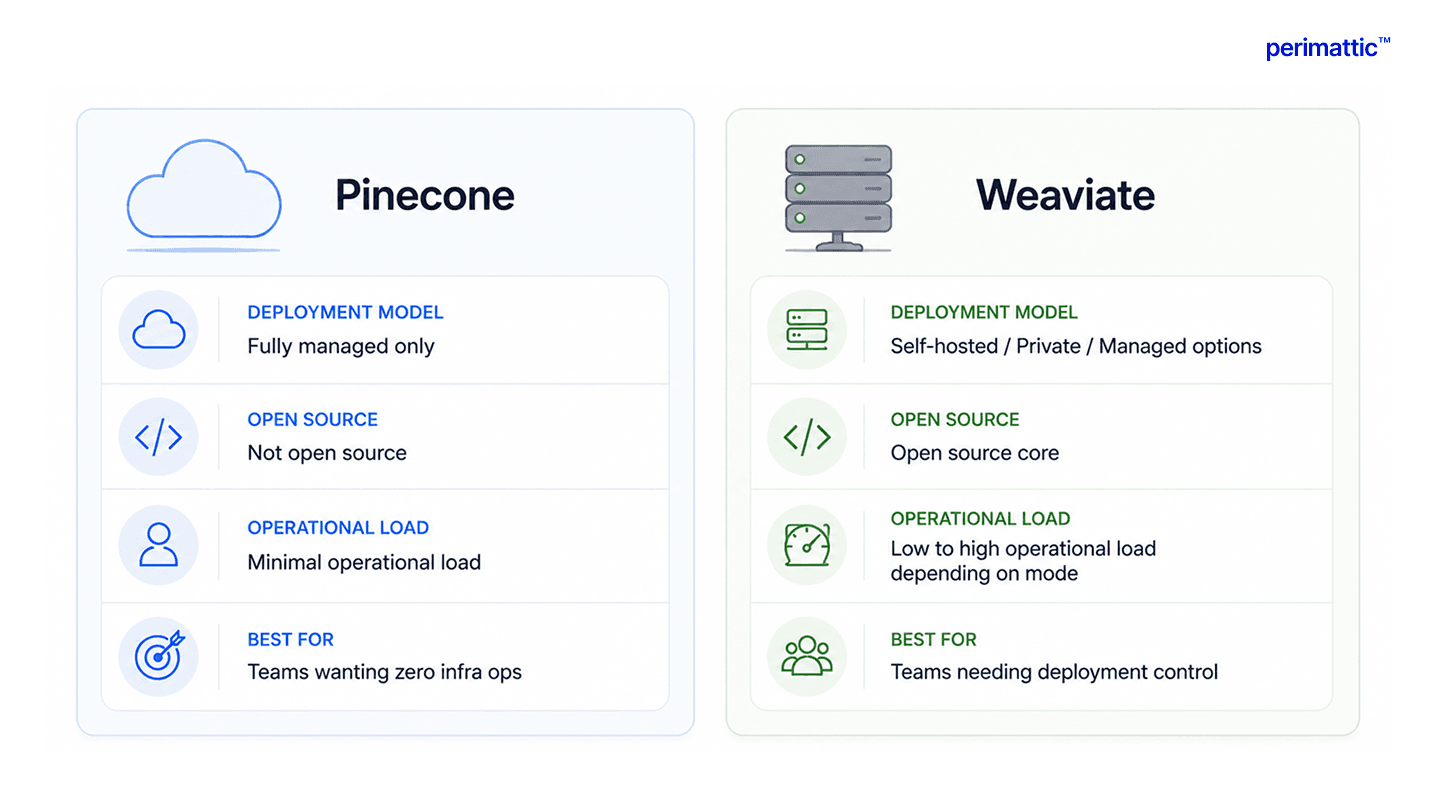
| Dimension | Pinecone | Weaviate |
|---|---|---|
| Deployment model | Fully managed only, with no self-hosted option. | Self-hosted, private cloud, or managed cloud. |
| Open source | No. | Yes, the core database is open source. |
| Hybrid search (vector + keyword) | Supported. | Native, built-in from the ground up. |
| Query interface | REST / gRPC API. | GraphQL and REST. |
| Operational overhead | Minimal, as Pinecone manages scaling and infrastructure. | Low with managed cloud, higher if self-hosted. |
| Data residency control | Limited to Pinecone's supported cloud regions. | Full control if self-hosted. |
| Multi-tenancy | Namespace-based, built into the managed service. | Supported, with configuration depending on deployment mode. |
| Best fit | Teams that want infrastructure fully abstracted away. | Teams that want deployment flexibility or already run open-source infrastructure. |
Decision Framework: Which One Fits Your Situation
The choice usually comes down to a small number of real constraints, not a feature-by-feature scoring exercise.
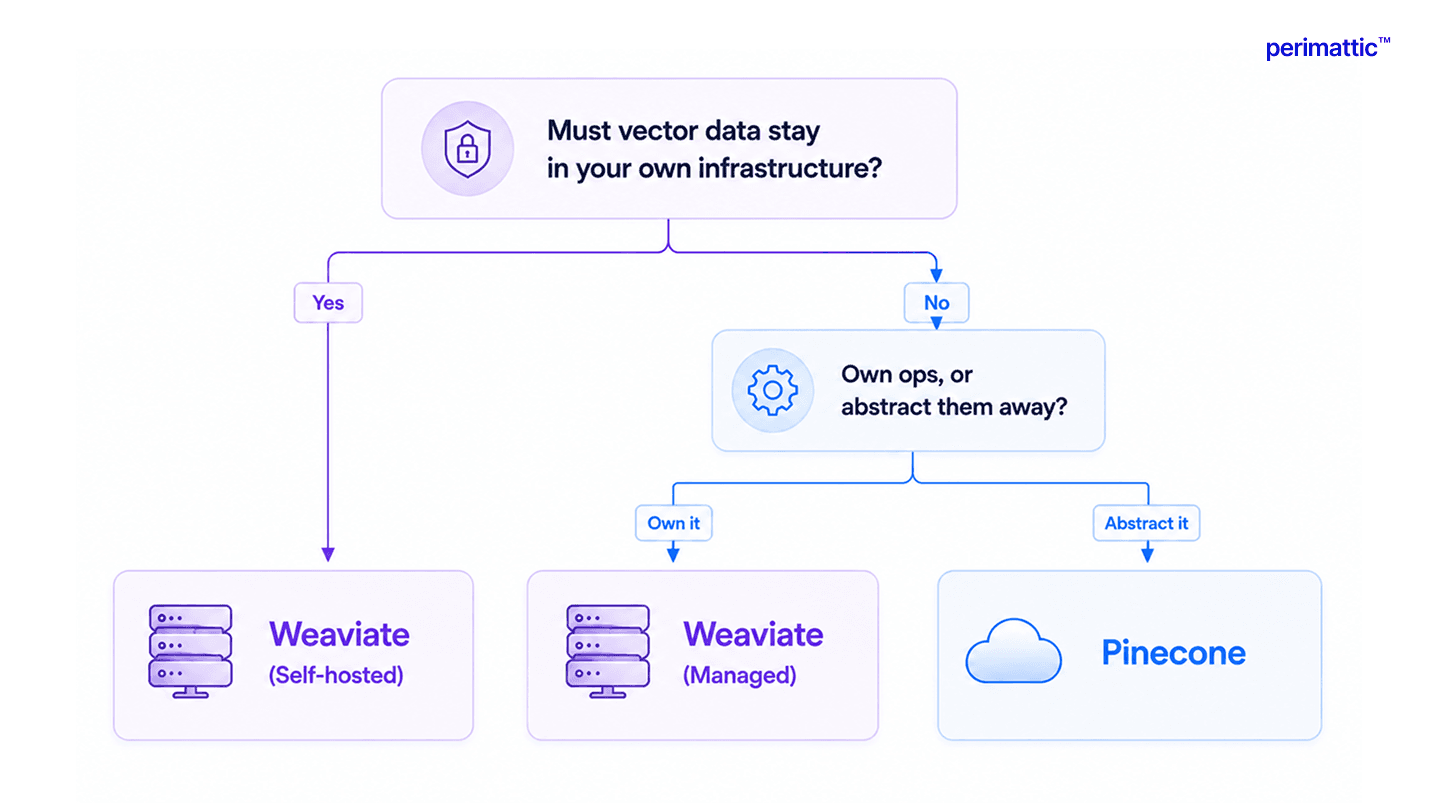
Choose Pinecone if: the priority is minimizing operational overhead, the team doesn't want to own vector infrastructure scaling and maintenance, and there's no hard requirement to keep vector data within a specific self-managed environment.
Choose Weaviate if: data residency, compliance, or architectural requirements mean self-hosting is necessary or strongly preferred, the team wants the option to combine keyword and vector search natively in a single query, or there's already open-source infrastructure expertise in-house that makes self-hosting a manageable operational addition rather than a new burden.
Either can work if: the use case is a standard RAG application without unusual compliance or hosting constraints, in which case the decision often comes down to which platform's specific tooling, pricing model, and developer experience the team prefers after a hands-on evaluation, rather than a hard technical differentiator.
A Note on Benchmarks
Vector database benchmarks change quickly as both platforms ship new indexing algorithms, pricing models, and performance optimizations, often multiple times a year. Rather than citing specific latency or throughput numbers here that are likely to be outdated by the time you're reading this, the more durable advice is to run a proof-of-concept against your own data and query patterns before committing. Both Pinecone's documentation and Weaviate's documentation publish current benchmarking guidance directly, and given how fast this space moves, that's a more reliable source than any single third-party comparison, this one included.
Beyond the Database: What Actually Determines RAG Quality
It's worth naming directly that the vector database is rarely the deciding factor in whether a RAG system actually performs well. Chunking strategy, embedding model quality, retrieval ranking, and prompt design typically matter more to end-to-end output quality than which vector database is underneath. Teams sometimes spend disproportionate time on the database decision and comparatively little on these other layers, then wonder why retrieval quality is disappointing despite choosing a well-regarded database. Getting all of these pieces right together is generally the work covered under custom LLM development services, where the vector database is one component in a larger retrieval architecture rather than the whole solution.
Migration Considerations
Switching between vector databases later isn't trivial, but it's also not the irreversible decision it can feel like upfront. Because both platforms expose embeddings and metadata through standard APIs, re-indexing existing data into a different database is generally a matter of re-running the embedding and upload pipeline rather than a full application rewrite, assuming the application layer was built with reasonable separation between the retrieval logic and the specific vector database API. Teams building a new RAG system for the first time are often better served focusing on getting that separation right in the application architecture than trying to guarantee a perfect database choice on day one, since the architecture decision is harder to unwind later than the database choice is.
Operating a Vector Database in Production
Choosing a vector database is a starting point, not a finish line. Once a RAG system is live, the operational questions shift toward monitoring retrieval quality over time: are queries returning genuinely relevant results as the underlying data grows and changes, is embedding drift degrading match quality as content evolves, and is query latency staying within acceptable bounds as index size scales up. These aren't questions either vendor's dashboard fully answers out of the box, and they tend to require the same kind of production monitoring discipline that any LLM observability practice builds around the rest of an AI system, tracking retrieval quality and output relevance rather than just infrastructure uptime.
This operational layer is also where the difference between a proof-of-concept RAG demo and a production-grade AI application tends to show up most clearly. A demo can tolerate an occasional irrelevant retrieval result. A production system serving real users at scale needs monitoring that catches degrading retrieval quality before it becomes visible as a wave of worse LLM outputs, which is a meaningfully different bar than getting the initial database selection right.
How This Fits Into a Broader AI Architecture
A vector database rarely operates in isolation. It typically sits alongside an embedding pipeline that processes and vectorizes new content as it arrives, an orchestration layer that decides when and how to query the database versus relying on the model's own knowledge, and a monitoring layer that tracks whether the whole retrieval chain is actually improving output quality. Building this end to end, rather than treating the vector database choice as the primary architectural decision, is generally the difference between a RAG system that works reliably in production and one that works well in a demo but degrades under real-world usage patterns, the kind of full-lifecycle work covered in how to build an AI agent when retrieval is one component of a larger autonomous system rather than a standalone search feature.
Pricing Model Differences Worth Understanding Upfront
Pinecone's serverless pricing scales with actual usage, storage and query volume, which can make costs harder to forecast precisely in advance but avoids paying for idle capacity during low-traffic periods. Weaviate's self-hosted option shifts cost from a per-usage vendor fee to infrastructure and operational cost, potentially cheaper at very large, steady-state scale, but only if the team already has the expertise to run it efficiently, since inefficient self-hosted infrastructure can easily cost more than a well-optimized managed service once engineering time is factored in. Weaviate's managed cloud option sits closer to Pinecone's model in terms of predictability. Neither pricing model is categorically cheaper; the right comparison depends on expected query volume, data size, and whether the team already has infrastructure operations capacity to absorb self-hosting, the same kind of cost modeling that matters for MLOps infrastructure generally, where compute costs for AI workloads rarely follow the predictable patterns of traditional application hosting.
Conclusion
Pinecone and Weaviate solve the same underlying problem from two different philosophies: Pinecone bets that most teams would rather not think about vector infrastructure at all, while Weaviate bets that flexibility and deployment choice matter enough to be worth the added operational surface. Neither bet is wrong. The right choice depends on constraints that have nothing to do with which database is objectively "better," data residency requirements, existing infrastructure expertise, and how much operational ownership the team actually wants. Get that decision right, and then spend the bulk of the remaining engineering effort on chunking, embeddings, and retrieval quality, since that's usually where RAG systems actually win or lose.