

Key Takeaways
- MLOps builds on DevOps practices such as CI/CD, infrastructure as code, version control, automation, and monitoring, but adds ML-specific capabilities.
- Unlike application code, ML models can degrade over time as real-world data changes, even when the code and infrastructure remain unchanged. This is known as model drift.
- MLOps requires data and model versioning together so teams can reproduce exactly how a model was trained and deployed.
- Model evaluation becomes a pipeline stage, covering metrics such as accuracy, fairness, and performance, rather than relying only on traditional software tests.
- Production ML systems need drift detection and retraining triggers to identify declining model performance and initiate retraining when required.
- LLM deployments introduce additional challenges such as retrieval pipelines, prompt templates, multi-step reasoning, hallucinations, and output quality, requiring specialized observability.
- Teams should start MLOps with reproducibility, automated evaluation, drift monitoring, and defined retraining processes before expanding into more advanced capabilities.
- MLOps also requires attention to ML-specific infrastructure costs, particularly GPU-heavy training and inference workloads.
AI Model Monitoring Services
Knowing what changes isn't the same as watching it in production. Our team sets up accuracy, drift and alerting for your models so problems surface before users notice.
Teams that are good at DevOps often assume that skill transfers directly to shipping machine learning models. It transfers partially. The CI/CD instincts, the automation mindset, the discipline around monitoring and rollback, all of that carries over. But ML systems break in ways traditional software doesn't, and treating a model deployment exactly like a code deployment is one of the more common reasons ML projects stall before they ever reach production.
The Core Difference: Code Doesn't Decay, Models Do
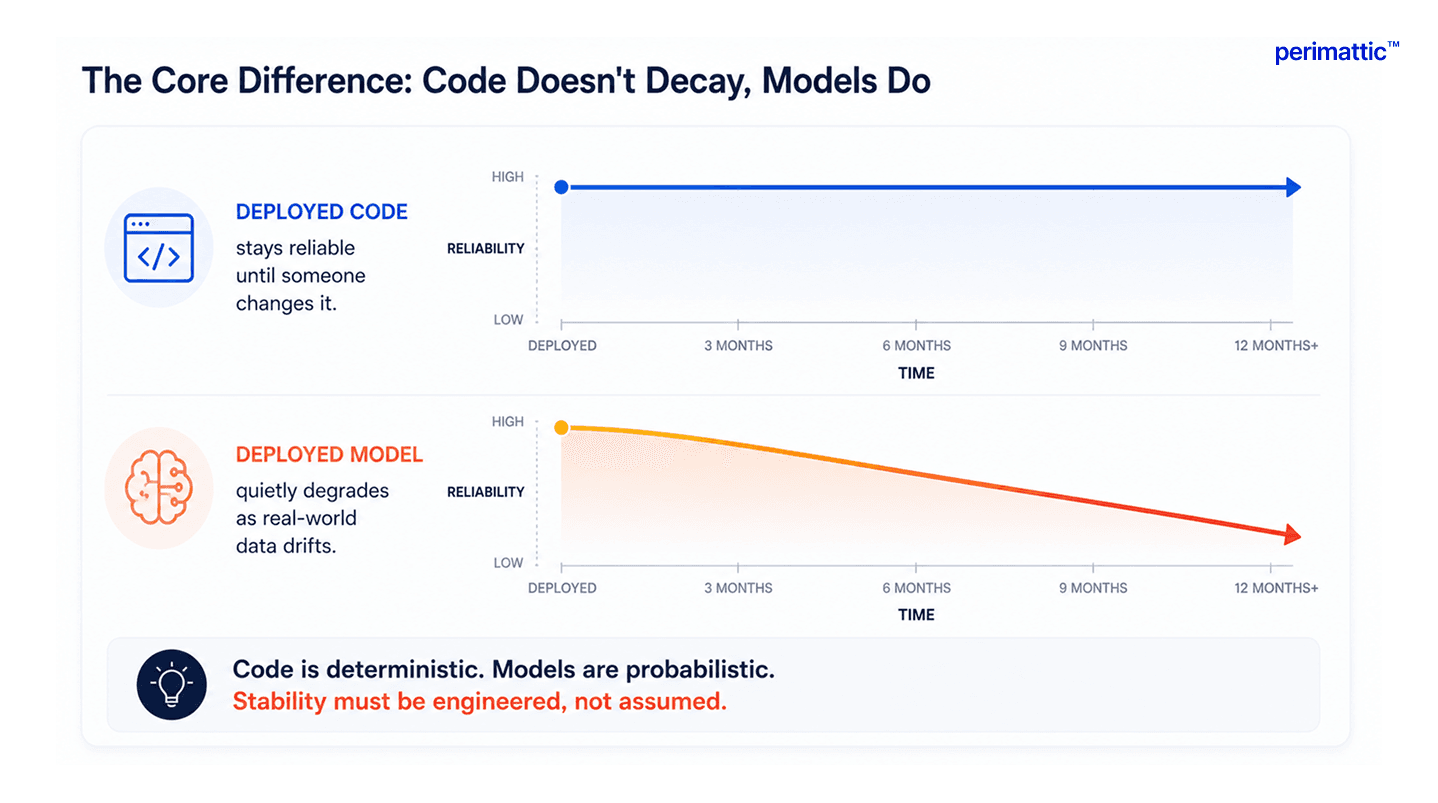
A traditional application, once deployed and working, keeps working until someone changes the code or the underlying infrastructure shifts. An ML model is different. Its behavior depends on the statistical relationship between its training data and the real world, and that relationship changes over time even when nothing about the code changes at all. This is called model drift, and it's the single biggest conceptual difference between DevOps and MLOps.
A recommendation model trained on last year's customer behavior can quietly get worse every month as customer behavior shifts, with no code changes, no deployment, and no error logs to flag it. Traditional monitoring, which watches for crashes, latency spikes, and error rates, won't catch this. The system stays "up" the entire time while quietly making worse predictions.
Why So Many ML Projects Never Make It to Production
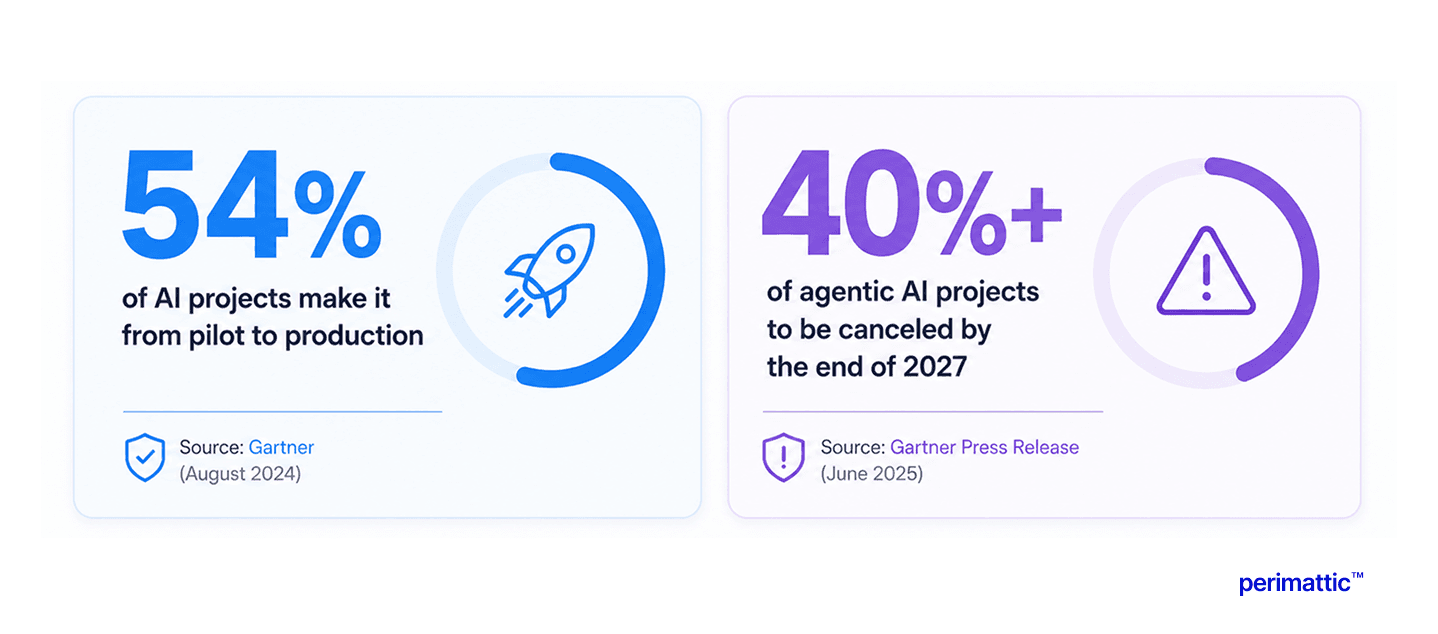
This gap between traditional software monitoring and what ML actually needs is a major reason so many ML initiatives stall. Gartner has found that on average, only 54% of AI projects make it from pilot to production, and for agentic AI specifically, Gartner projects that over 40% of agentic AI projects will be canceled by the end of 2027 due to escalating costs, unclear business value, or inadequate risk controls. These aren't primarily modeling failures. They're operational failures, the absence of the deployment discipline, monitoring, and governance that MLOps is specifically built to provide.
What Carries Over From DevOps
MLOps isn't a completely separate discipline built from scratch. A meaningful amount of DevOps practice transfers directly:
- Version control, though extended to cover not just code, but also datasets, model artifacts, and experiment configurations, since reproducing a specific model result requires knowing exactly what data and parameters produced it.
- CI/CD automation, adapted into pipelines that also include model training, evaluation, and validation steps before a new model version is promoted to production.
- Infrastructure as code, for provisioning the (often GPU-heavy) compute infrastructure that training and inference require.
- The cultural instinct toward automation and repeatability, treating manual, one-off model deployment the same way DevOps treats manual, one-off server configuration: as a liability, not a shortcut.
What's Genuinely New in MLOps
Data and model versioning, together. In traditional DevOps, code is the artifact that gets versioned and deployed. In ML, the model's behavior depends equally on the training data and the code, so both need to be versioned together, and reproducibility requires being able to answer "what data and what code produced this exact model" months after the fact.
Model evaluation as a pipeline stage. A traditional CI pipeline runs tests that either pass or fail. A model pipeline needs to evaluate accuracy, fairness, and performance against a validation set, and decide whether the new model version is actually better than the one currently in production, a fundamentally more nuanced gate than a binary pass/fail test suite.
Drift detection and retraining triggers. Because model quality degrades on its own over time, MLOps needs monitoring that specifically watches for the statistical distance between production data and training data drifting apart, and automated or semi-automated processes for retraining and redeploying when that drift crosses a threshold.
Experiment tracking. Getting to a production-ready model usually involves dozens or hundreds of training runs with different data, parameters, and architectures. MLOps needs tooling to track which experiments were run, what their results were, and which one actually got promoted, a category of work that has no direct DevOps equivalent.
Side-by-Side: DevOps vs MLOps
| Aspect | DevOps | MLOps |
|---|---|---|
| Primary artifact | Application code. | Code, training data, and model weights together. |
| What "testing" means | Unit, integration, and regression tests. | All of that, plus model accuracy, bias, and drift evaluation. |
| Failure mode | Crashes, errors, and downtime, usually visible immediately. | Silent degradation in prediction quality over time. |
| Monitoring focus | Uptime, latency, and error rates. | All of that, plus data drift, prediction accuracy, and fairness metrics. |
| Retraining need | Not applicable, code doesn't decay on its own. | Ongoing, since model performance degrades as real-world data shifts. |
| Rollback complexity | Revert to a previous code version. | Revert to a previous model version, which may also require reverting associated data pipelines. |
| Team composition | Developers and operations engineers. | Adds data scientists and ML engineers to that mix. |
Where LLM Deployments Add Another Layer
Deploying large language models introduces problems that go beyond even traditional MLOps. Instead of a single model making a bounded prediction, an LLM-based system often involves retrieval pipelines, prompt templates, and multi-step reasoning chains, all of which can degrade or misbehave independently of the underlying model itself. Tracking hallucination rate, latency, and output quality requires a different kind of observability than traditional ML monitoring, since correctness in a generative system is harder to define with a single accuracy metric. This is a big part of why LLM observability and AI monitoring has emerged as its own specialized discipline sitting on top of general MLOps practice, rather than being treated as identical to monitoring a traditional classification or regression model.
Building an MLOps Practice: Where to Start
Organizations new to MLOps tend to get better results starting narrow rather than trying to build a comprehensive platform on day one:
- Start with reproducibility. Before anything else, make sure any production model's training data, code, and configuration can be traced and reproduced. Without this, every later step is built on an unstable foundation.
- Add automated evaluation gates. Require new model versions to beat a defined performance baseline before they're promoted, the ML equivalent of a CI test suite that must pass before merge.
- Instrument for drift, not just uptime. Traditional monitoring tells you the system is running. Drift monitoring tells you whether it's still making good predictions, and that gap is where most silent ML failures live.
- Define a retraining trigger and process, whether that's a scheduled cadence or a drift-threshold trigger, so retraining is a defined process rather than something that only happens reactively once someone notices the model has clearly gotten worse.
- Bring in dedicated MLOps expertise early rather than late. Retrofitting these practices onto an ML system that's already in production, with no versioning discipline and no drift monitoring, is considerably harder than building them in from the start, which is where dedicated MLOps services tend to add the most value, particularly for teams whose core expertise is data science rather than production infrastructure.
The Team and Skills Question
A DevOps team is typically built around software engineering and systems administration backgrounds. MLOps needs that same foundation, but it also needs people who understand how models are trained, evaluated, and validated, which is a different skill set from infrastructure engineering alone. In practice, this usually shows up as one of two patterns: either an existing DevOps or platform team adds ML-specific expertise as it takes on model deployment responsibilities, or a dedicated MLOps function sits between the data science team and the platform team, translating experimental model work into something that can actually run reliably in production.
Neither structure is inherently better, but the mistake to avoid is assuming the existing DevOps team can absorb MLOps responsibilities without any new skills or tooling. Data versioning, experiment tracking, and drift monitoring are specialized enough that treating them as a minor extension of existing DevOps practice tends to produce exactly the kind of operational gap that leaves ML projects stuck in the 46% that never make it past pilot.
Cost Considerations Unique to MLOps
Infrastructure cost management looks different for ML workloads than for traditional applications, largely because training and inference workloads are far more compute-intensive and far less predictable in their resource needs than a typical web application. A training run might need a burst of expensive GPU compute for a few hours or days, then nothing until the next retraining cycle, a usage pattern that doesn't map cleanly onto the steady-state cost optimization playbook most cloud cost management practices are built around. Production system costs handling meaningful inference volume can run into thousands of dollars per month in compute alone before accounting for storage, data transfer, and tooling, which makes cost visibility for ML workloads specifically, not just general cloud cost management, an important part of a mature MLOps practice.
This is also where the earlier stages of a project matter. Teams that scope their AI development work with a realistic view of ongoing inference and retraining costs, not just the upfront build cost, tend to avoid the unpleasant surprise of a model that works well in testing but is expensive to operate at production volume.
Final Thoughts
MLOps isn't DevOps with a rebrand, and treating it that way is exactly why so many ML initiatives get stuck in pilot purgatory instead of shipping. The automation instincts and CI/CD discipline from DevOps genuinely carry over, but the failure modes are different: code doesn't quietly get worse on its own, models do. Building in data versioning, evaluation gates, and drift monitoring from the start, rather than retrofitting them after a model is already misbehaving in production, is the difference between an ML system that stays reliable and one that silently degrades until someone finally notices the numbers don't look right anymore.