
Key Takeaways
- Identify common sources of cloud waste, including idle resources, oversized instances, unused commitment discounts, AI/GPU sprawl, and shadow infrastructure.
- Use the three FinOps phases, Inform, Optimize, and Operate, to build sustainable cloud cost management practices.
- Right-size compute, remove unused resources, optimize commitment discounts, and automate non-production environment shutdowns to reduce unnecessary spend.
- Build cost awareness into engineering workflows by making cloud cost a measurable operational metric and integrating cost checks into CI/CD pipelines.
- Avoid treating cloud cost optimization as a one-time project. Continuous governance is essential to prevent savings from gradually disappearing.
- Adapt cost optimization strategies to the pricing models and capabilities of AWS, Azure, and Google Cloud rather than applying one generic approach.
- Track metrics such as cost per unit of value, waste rate, forecast accuracy, and time to detect anomalies to measure whether optimization efforts are working.
- AI and GPU workloads require additional cost governance because they can be difficult to right-size and may continue running beyond their intended use.
Cloud Migration Services
A practical guide gets you 80% of the way — our cloud team handles the rest, from workload-level rightsizing to a zero-downtime migration plan that keeps costs down after launch too.
Cloud bills rarely go down on their own. They creep up quietly, one unattached volume, one oversized instance, one forgotten staging environment at a time, until a finance leader forwards the AWS invoice to engineering with a single question mark in the subject line. This guide is for the engineers who then have to answer that question, and for the teams who want to get ahead of it before it happens.
Why Cloud Costs Keep Rising Even When Usage Doesn't
According to Flexera's 2026 State of the Cloud Report, estimated wasted cloud spend climbed to 29% this year, the first increase in five years after a steady decline. That reversal matters because it wasn't caused by teams getting careless. It was caused by AI workloads, new pricing models, and expanding service catalogs making cost forecasting genuinely harder than it used to be. The same report found that 76% of large enterprises now spend more than $5 million a month on public cloud, so even a small percentage of waste translates into real budget.
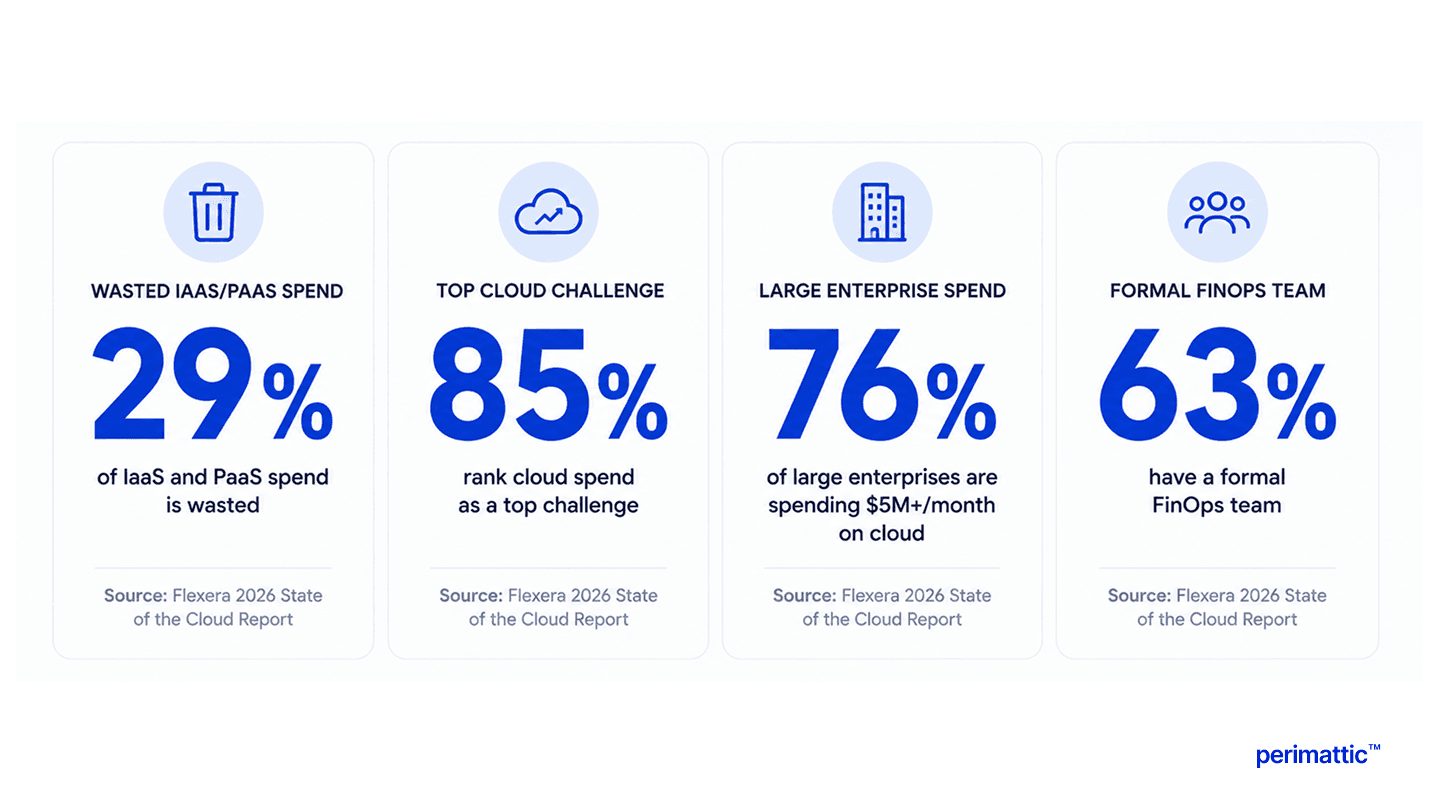
Managing cloud spend has held the top spot among cloud challenges for four years running, with 85% of organizations naming it their biggest concern, ahead of security and software licensing. That's not because teams don't care about cost. It's because cost visibility and cost control are two different problems, and most tooling only solves the first one.
Where the Waste Actually Comes From
Cloud waste tends to cluster around a handful of repeatable patterns:
- Idle and orphaned resources. Load balancers with no traffic, unattached storage volumes, snapshots nobody ever cleans up, and dev/test environments left running over weekends and holidays.
- Oversized instances. Provisioning for peak load and never revisiting the sizing once traffic patterns change, or copying a production instance type into staging "just to be safe."
- Unused commitment discounts. Reserved instances or savings plans purchased once and then never adjusted as workloads shift, so the discount stops matching actual usage.
- AI and GPU sprawl. Flexera's report specifically calls out AI workloads as a driver of the recent uptick in waste, since GPU-based training and inference jobs are harder to right-size than traditional compute and easy to leave running past when they're needed.
- Shadow infrastructure. Resources spun up by individual engineers or teams outside of any tagging or governance process, which makes them invisible to whoever owns the cost review.
None of these are exotic problems. They're the predictable result of infrastructure growing faster than the processes meant to govern it, which is exactly the gap FinOps practices exist to close.
The FinOps Foundation: Cost Visibility, Optimization, and Governance
FinOps is typically described in three iterative phases, and skipping straight to the third one is the most common mistake teams make.
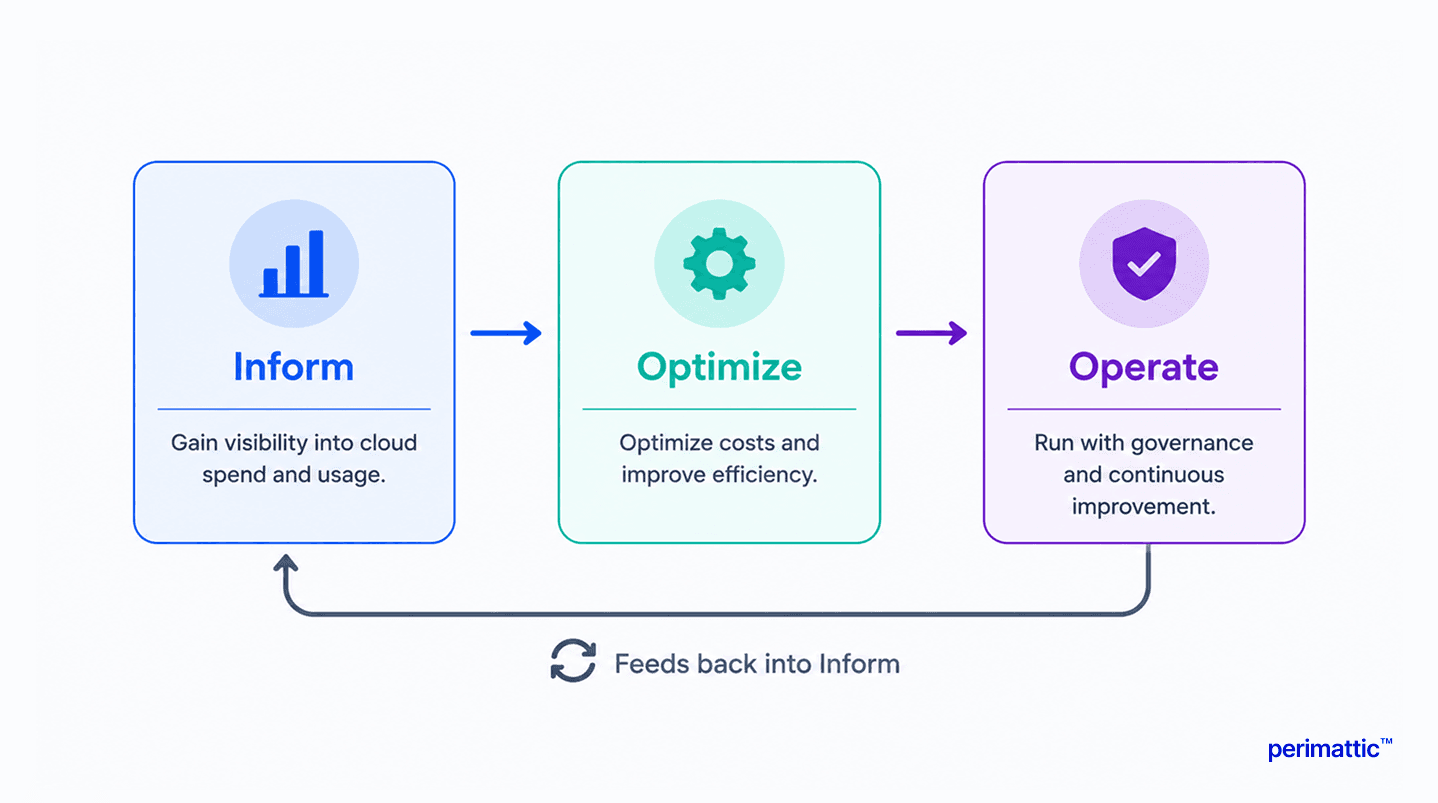
Inform is the visibility phase: tagging resources consistently, allocating spend to the teams and services that generate it, and giving engineers a real-time view of what their decisions cost. Without this phase, every optimization conversation turns into a guessing game.
Optimize is where the tactical work happens: rightsizing instances, cleaning up idle resources, adjusting commitment discounts, and choosing more cost-efficient architectures for a given workload.
Operate is the governance phase: building the review cadence, alerting, and organizational ownership that keeps costs from drifting back up once the initial cleanup is done. Flexera found that 71% of organizations now operate a formal Cloud Center of Excellence and 63% have a dedicated FinOps team, evidence that this governance layer has become standard practice rather than a nice-to-have.
A Practical Cost Optimization Checklist for Engineering Teams
The following isn't exhaustive, but it covers the changes that tend to produce the largest, fastest wins without requiring a full re-architecture:
| Action | Typical Impact | Effort |
|---|---|---|
| Tag every resource by owner, team, and environment | Enables accurate cost allocation, the foundation for everything else. | Low |
| Right-size compute instances based on actual utilization, not peak estimates | Often the single largest cost reduction available. | Medium |
| Automatically shut down non-production environments outside business hours | Direct, easy-to-measure savings on dev/test/staging. | Low |
| Clean up unattached storage volumes and old snapshots | Small individually, but compounds quickly at scale. | Low |
| Match commitment discounts (reserved instances, savings plans) to actual usage patterns | Meaningful savings on steady-state workloads. | Medium |
| Set budget alerts and anomaly detection at the team or service level | Catches problems in days instead of at month-end. | Low |
| Review architecture for workloads that could move to spot instances or serverless | Can be substantial for interruption-tolerant or bursty workloads. | High |
Building Cost Awareness Into Engineering Culture
The teams that sustain cost improvements, rather than doing a one-time cleanup that quietly regresses six months later, tend to do a few things differently. They put cost data in front of the engineers actually making infrastructure decisions, not just in a monthly finance report nobody on the engineering team ever opens. They treat cost the way they treat performance or reliability, as a metric with an owner and a target, not an afterthought. And they build cost checks into the same CI/CD pipelines that already gate for tests and security, so an oversized instance type gets flagged before it ships rather than discovered on next month's bill. This is increasingly where cloud cost optimization overlaps with broader DevOps as a service practices, since the tooling and automation that make deployments reliable are the same tooling and automation that make cost visibility possible.
When to Bring in Outside Help
Not every team needs a dedicated FinOps hire or an outside partner. But a few signals tend to indicate that outside expertise pays for itself quickly: cloud spend that's grown faster than anyone can explain, a multi-cloud or hybrid environment where cost data lives in three different dashboards that don't talk to each other, or an engineering team that's too busy shipping product to also own ongoing cost governance. A cloud managed services provider can take on exactly that ongoing cost monitoring and optimization work, essentially acting as the FinOps function a smaller team doesn't have the bandwidth to build in-house. This is also where unresolved cost inefficiency starts to resemble technical debt, a problem that's cheap to ignore in any single month and expensive to unwind after it's compounded for a year.
Common Cost Optimization Mistakes
A few mistakes show up often enough to be worth naming directly.
**Treating cost optimization as a one-time project. ** A cleanup sprint that isn't followed by ongoing governance tends to regress within a year, since the same forces that created the original waste, growing teams, new services, changing traffic patterns, never stop operating. The "Operate" phase of FinOps exists specifically to prevent this pattern, and skipping it is the single most common reason a successful cost cleanup doesn't stay successful.
**Optimizing without understanding the business context. ** An instance running at low average utilization isn't automatically wasteful if it needs to handle occasional traffic spikes reliably. Cutting it down to match average load can trade a cost problem for a reliability problem, which usually costs more in the long run than the savings were worth. Cost decisions need to sit next to performance and reliability requirements, not override them.
Ignoring commitment discount management. Reserved instances and savings plans are one of the more reliable ways to reduce steady-state compute costs, but they require active management. Flexera's report notes that despite clear savings available, fewer than half of organizations are using even one commitment discount per cloud provider, leaving predictable, low-risk savings unclaimed simply because nobody owns reviewing and adjusting them.
**Letting cost visibility stop at the infrastructure team. ** If the engineers actually deciding what to provision never see what it costs, cost awareness has nowhere to take root. The organizations with the best track record on sustained savings tend to be the ones that push cost data down to individual teams and services, not just up to a finance dashboard.
How Cloud Provider Choice Affects Cost Strategy
The three major providers approach pricing differently enough that cost strategy shouldn't be identical across them.
AWS has the broadest and most granular pricing model, with the most reserved instance and savings plan options, but that flexibility also means the most opportunity for misconfiguration and unused discounts if nobody is actively managing it. Azure tends to reward organizations already committed to the Microsoft ecosystem through licensing bundles and hybrid benefit programs, which can meaningfully change the cost calculus for enterprises with existing Microsoft agreements. Google Cloud applies sustained-use discounts automatically in many cases, which reduces the baseline waste risk for teams that haven't yet built out active commitment management, though it still rewards active optimization for larger, more complex environments. None of this means one provider is categorically cheaper. It means the cost optimization playbook has to account for how each provider's pricing model actually works, rather than applying a single generic checklist across a multi-cloud environment.
Measuring Whether Your Optimization Efforts Are Actually Working
Cost optimization has a habit of feeling productive without being measurable. A few metrics keep it honest:
- Cost per unit of value, whether that's cost per customer, per transaction, or per active user, rather than raw total spend, which naturally rises as the business grows.
- Waste rate, the percentage of spend that delivers no measurable business value, tracked over time rather than as a one-time snapshot.
- Forecast accuracy, how close actual spend lands to what was budgeted, since wildly inaccurate forecasts are usually a sign that governance, not just optimization, needs attention.
- Time to detect anomalies, how quickly an unexpected spend spike gets caught and addressed, which is a good proxy for whether the "Operate" phase of FinOps is working.
Tracking these alongside the broader return on a DevOps investment helps make the business case for continued investment in cost tooling and process, rather than treating a single successful cleanup as the finish line.
Conclusion
Cloud waste isn't a sign of a badly run engineering team. It's what happens by default when infrastructure scales faster than the visibility and governance built to manage it, and the industry-wide data backs that up: waste rose for the first time in five years in 2026, even as FinOps maturity kept climbing. The fix isn't a single cleanup sprint. It's building cost visibility into everyday engineering decisions, treating cost like any other operational metric with an owner and a target, and revisiting governance regularly enough that savings don't quietly erode. Teams that get this right don't spend less because they stopped growing, they spend less because every dollar of cloud spend is doing something the business can point to.