


Key Takeaways
- DevOps is a culture and set of practices for shared ownership across development and operations. Platform engineering is a discipline for building the internal tooling that makes those practices scalable.
- Platform engineering doesn't replace DevOps, it operationalizes it, particularly in organizations that have outgrown what ad hoc, team-by-team DevOps can support.
- The two disciplines share tooling but differ in scope: DevOps optimizes for a team's own delivery pipeline, platform engineering optimizes for every team's delivery pipeline at once.
- Adoption is accelerating quickly, with Gartner projecting 80% of large engineering organizations will have dedicated platform teams within the next year or two, up from under half in 2022, and 88% of tech executives now calling platform engineering crucial to their objectives.
- The transition takes real time to pay off. Treat a new platform team as a multi-quarter investment, not a quick fix.
DevOps & Platform Engineering Services
GitOps pipelines, Kubernetes platforms, and managed DevOps that give your teams the infrastructure speed this article describes — without the in-house overhead.
If you've spent any time in engineering leadership circles over the past two years, you've probably heard some version of this claim: "DevOps is dead, platform engineering is the future." It's a catchy line, and it gets clicks, but it's also mostly wrong. Platform engineering didn't replace DevOps. It grew out of it, in response to specific problems that DevOps, as originally practiced, never fully solved.
This post breaks down what platform engineering is, how it differs from DevOps in practice (not just in marketing copy), and where the two disciplines overlap. Along the way, you'll find comparison tables you can bookmark, share with your team, or use as a quick reference the next time someone in a planning meeting asks, "Wait, don't we already do this?"
The Short Answer
DevOps is a cultural philosophy and a set of practices aimed at breaking down the wall between development and operations teams, so software gets built, tested, and released faster and more reliably. Platform engineering is the discipline of building internal tools, self-service systems, and "golden paths" that let developers apply DevOps principles without needing to become infrastructure experts themselves.
Simply: DevOps told teams to own their own infrastructure and deployments. Platform engineering builds the paved road that makes that ownership actually manageable at scale.
Why This Question Keeps Coming Up
DevOps emerged in the late 2000s as a reaction to a very real problem: developers wrote code and threw it over a wall to an operations team, who then had to figure out how to run it in production. Communication was slow, blame was constant, and releases were painful. The DevOps movement asked a simple question: what if the people who build the software also help run it?
That idea worked well in small and mid-sized teams. Each squad owned its pipeline, its infrastructure-as-code, its monitoring, and its on-call rotation. But as organizations scaled from a handful of services to hundreds, something broke down. Every team was reinventing the same Terraform modules, the same CI/CD pipelines, the same Kubernetes configurations, often with subtle and expensive differences that quietly add to an organization's technical debt long before anyone tracks it as such, and eventually require deliberate technical debt reduction work to unwind. Developers spent more time wrestling with YAML and cloud consoles than writing product code. Security and compliance teams struggled to enforce consistent guardrails across dozens of self-managed pipelines.
Platform engineering is the industry's answer to that scaling problem. Instead of asking every team to build its own path from code to production, a dedicated platform team builds one well-paved road, and treats it as a product that other engineers use. Much of this sprawl surfaces during application modernization work or when teams revisit their legacy system modernization strategy, since both efforts run headlong into the same duplicated pipelines and inconsistent tooling.
Defining Platform Engineering
Platform engineering is the practice of designing, building, and maintaining an internal developer platform (IDP), a set of self-service tools, APIs, and workflows that abstract away the underlying complexity of cloud infrastructure, CI/CD, and operational tooling. A platform team's "customers" are the organization's own developers, and the platform is treated with the same product discipline you'd apply to something you sell externally: it has a roadmap, it gets user feedback, and its success is measured by adoption and developer satisfaction, not just uptime.
The distinction matters because platform engineering isn't simply centralizing infrastructure. The platform is supposed to reduce the number of decisions individual developers have to make without taking ownership away from them. A good internal platform handles the repetitive and infrastructure-heavy parts of delivery while leaving product teams responsible for their applications, deployments, and production outcomes.
Typical outputs of a platform engineering team include:
- An internal developer portal (often built on something like Backstage) that gives engineers a single place to find services, documentation, and templates
- Self-service provisioning for infrastructure, so a developer can spin up a database or a new environment without filing a ticket
- Standardized CI/CD templates that bake in security scanning, testing, and deployment best practices by default
- Golden paths: pre-approved, well-documented ways to build and ship common types of services
- Centralized observability, secrets management, and cost visibility
Defining DevOps
DevOps is broader and less concrete by design. It's a set of cultural values and practices, not a specific tool or team structure. At its core, DevOps asks development and operations to share responsibility for the full software lifecycle: writing the code, testing it, deploying it, and keeping it running. The practical expression of DevOps usually includes continuous integration and continuous delivery (CI/CD), infrastructure as code, monitoring and observability, and blameless postmortems when things go wrong. It's a meaningful shift from traditional IT operations, where development and operations worked as separate, sequential teams.
Crucially, DevOps doesn't specify who does the work or how the tooling is organized. In a small startup, "DevOps" might mean every engineer owns their own pipeline and infrastructure. In a larger company, it might mean a central "DevOps team" (something the original DevOps movement warned against, since it can recreate the very silo DevOps was meant to eliminate).
That ambiguity is exactly the gap platform engineering tries to close.
Platform Engineering vs. DevOps: Core Comparison
| Dimension | DevOps | Platform Engineering |
|---|---|---|
| Primary focus | Culture and collaboration between dev and ops | Building reusable, self-service infrastructure and tooling |
| Deliverable | Practices, processes, shared responsibility | A concrete product, the internal developer platform |
| Who "owns" it | Ideally, every engineering team | A dedicated platform team |
| Customer | The business and end users | Internal developers, treated as platform users |
| Scope | Whole software delivery lifecycle | The tooling and infrastructure layer beneath that lifecycle |
| Success metric | Deployment frequency, lead time, MTTR | Developer adoption, time-to-first-deploy, cognitive load reduction |
| Origin | A cultural response to dev/ops silos (2009) | A scaling response to DevOps sprawl (early-to-mid 2020s) |
| Analogy | A philosophy of "you build it, you run it" | The paved road that makes "you build it, you run it" realistic |
The important point is that these aren't competing operating models. A team can practice DevOps without having a formal platform engineering function, just as a platform team can build sophisticated infrastructure without creating a genuinely effective developer experience. The difference is mainly one of scope: DevOps changes how teams own and deliver software, while platform engineering provides reusable capabilities that make that model easier to sustain across many teams.
How Do DevOps Engineers and Platform Engineers Differ Day to Day?
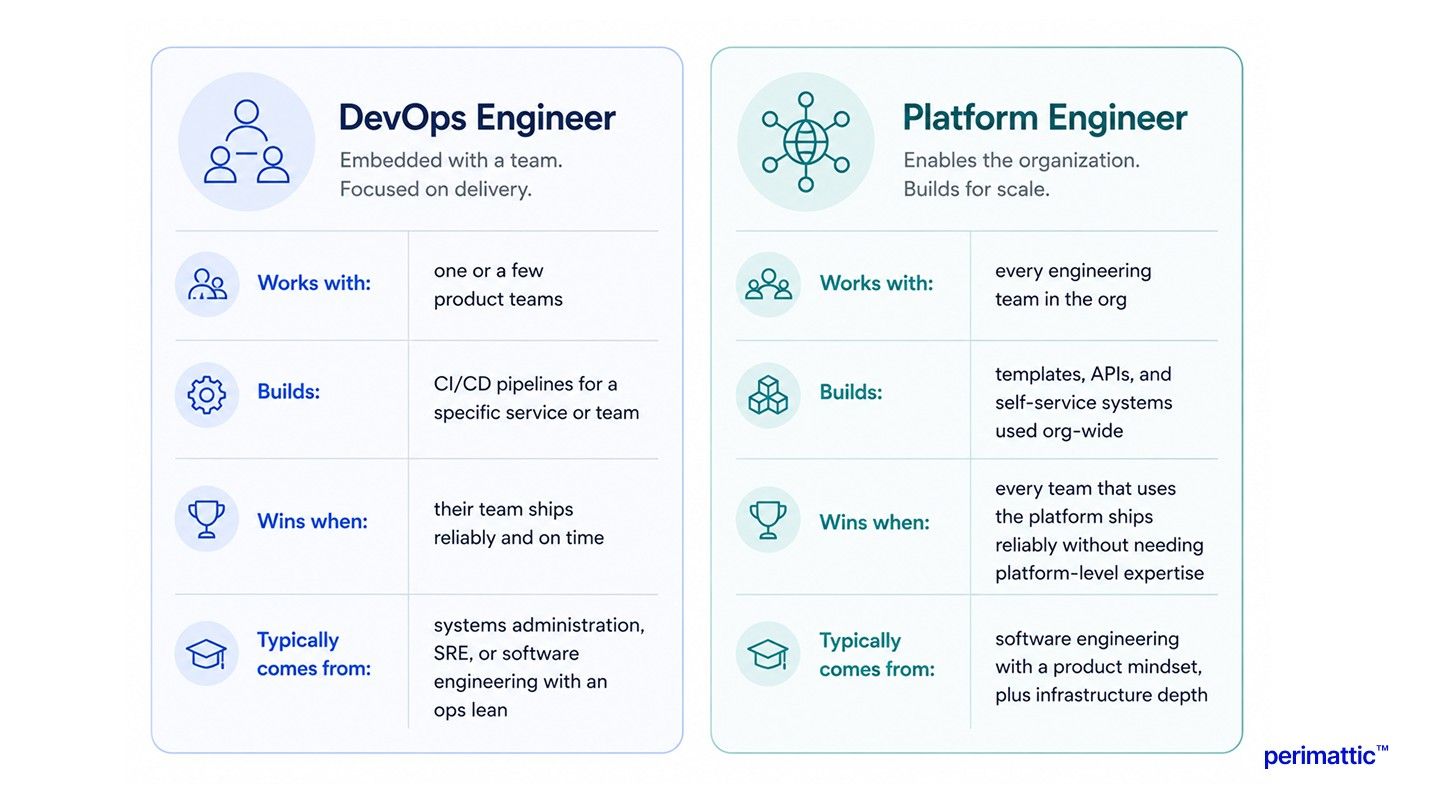
The org-chart question is usually where this debate gets the most heated, so it's worth being concrete about what each role does.
| Aspect | DevOps Engineer | Platform Engineer |
|---|---|---|
| Typical day | Manages pipelines for specific product teams, troubleshoots deployments, and tunes monitoring. | Designs and maintains the platform itself, writes internal tooling, and gathers requirements from developer "customers." |
| Interfaces with | One or a few product teams. | Every engineering team in the organization. |
| Builds | CI/CD pipelines for a specific service or team. | Templates, APIs, and self-service systems used across multiple teams. |
| Success looks like | Their team ships reliably and on time. | Every team using the platform ships reliably without requiring platform-level expertise. |
| Common background | Systems administration, SRE, or software engineering with an operations focus. | Software engineering, often with a product mindset, combined with deep infrastructure expertise. |
| Reports to / sits within | Often embedded in or paired with a product engineering team. | Usually part of a dedicated, centralized platform organization. |
Tooling and Tech Stack
Both disciplines overlap heavily on the underlying tools, but they use them differently.
| Category | DevOps Use | Platform Engineering Use |
|---|---|---|
| CI/CD | Individual pipelines configured per team. | Standardized, reusable pipeline templates rolled out organization-wide. |
| Infrastructure as Code | Terraform or Pulumi modules written and maintained by individual teams. | Curated, versioned modules published as self-service building blocks. |
| Container orchestration | Teams manage their own Kubernetes manifests. | A managed platform abstracts Kubernetes behind simpler interfaces. |
| Developer portal | Rarely a dedicated tool. | Central to the discipline (Backstage, Port, Cortex, etc.). |
| Observability | Per-team dashboards and alerts. | Centralized, standardized observability baked into every service by default. |
| Security and compliance | Enforced ad hoc, team by team. | Enforced by default through platform guardrails and policy-as-code. |
What's Changing in Platform Engineering in 2026
- The discipline is still moving fast, and a handful of shifts are showing up consistently across current platform engineering coverage:
- AI-augmented platform workflows. Platforms are starting to embed AI for intelligent test selection, risk-based change scoring, and anomaly detection, not just CI/CD automation. This mirrors how a dedicated MLOps practice formalizes AI/ML delivery, platform teams are beginning to formalize AI-assisted workflows the same way.
- FinOps built into provisioning. Cost governance is shifting from after-the-fact dashboards to pre-deployment cost gates that block services from shipping if they exceed budget thresholds, rather than flagging overspend after it's already happened.
- Platform-as-product maturity. Leading platform teams now track adoption with product-style metrics, like NPS and time-to-first-deploy, rather than treating the platform as a one-time infrastructure project with a fixed end date.
- Role specialization. "Platform engineer" is starting to split into sub-specialties, some focused on core infrastructure, others focused specifically on developer experience, as platform teams mature past their initial build phase.
Is Platform Engineering Just "DevOps Done Right"?
This is the most useful way to frame the relationship, and it's more accurate than "platform engineering replaced DevOps." Recent industry research backs this up. Gartner has projected that 80% of large software engineering organizations will have dedicated platform teams by 2026 or 2027, depending on the report cited, up from roughly 45% in 2022. That's a rapid shift, but it's a shift in structure and tooling, not a rejection of DevOps values. The goal, shared "you build it, you run it" ownership, hasn't changed. What's changed is the recognition that asking every team to build that capability from scratch doesn't scale past a certain org size.
Gartner has also found that 88% of tech executives now see platform engineering as crucial to meeting their organization's objectives, largely because a shared platform is what lets AI-assisted development, automated security scanning, and cost governance get applied consistently instead of team by team. Coverage of Google's own internal DevOps research has also pointed to a similar picture: a large majority of organizations now run at least one internal developer platform, and the maturity of that platform tends to track closely with how much value teams see from the practices layered on top of it, AI-assisted workflows included.
None of this means DevOps culture has become optional. It means the tooling layer that supports DevOps culture has professionalized into its own discipline, with its own team, roadmap, and success metrics.
When Do You Actually Need Platform Engineering?
These signals are really indicators of cognitive load rather than simple infrastructure volume. The question isn't whether developers can manage the underlying systems themselves; it's whether they should have to repeatedly solve the same infrastructure problems to ship product features. When those repeated decisions begin consuming meaningful engineering time, a platform can turn them into standardized capabilities instead of recurring work, much the same way implementing DevOps in the first place turns repeated manual releases into a repeatable process.
Not every organization needs a dedicated platform team, and building one too early can be as costly as not building one at all. A rough rule of thumb, drawn from how most engineering organizations describe their own inflection points:
| Signal | What It Suggests |
|---|---|
| Fewer than 20 to 30 engineers and one or a handful of services | Standard DevOps practices are usually sufficient. |
| Multiple teams independently rebuilding similar pipelines and infrastructure | A strong signal that a platform team would reduce duplicated effort. |
| Developers spending significant time on infrastructure tasks unrelated to product work | A classic sign of excess cognitive load that a platform can absorb. |
| Inconsistent security or compliance posture across teams | Platform-level guardrails enforce consistency that ad hoc DevOps cannot. |
| Onboarding new engineers takes weeks before they can ship anything | A golden path and self-service tooling directly address this challenge. |
Industry write-ups on 2026 platform adoption note a recurring pitfall here: organizations sometimes stand up a platform team and expect immediate productivity gains, but time-to-value is often six to twelve months, and can stretch well past a year for complex environments. A platform team is an investment with a real ramp-up period, not an overnight fix, and the same patience applies when measuring DevOps ROI more broadly, the business value tends to show up later than the initial investment does.
How Platform Initiatives Fail
The ramp-up period above is exactly where platform initiatives tend to go wrong, and the failure modes are consistent enough to name directly:
Scope creep into a ticket queue. A platform team that takes on too much ad hoc support work becomes the new infrastructure bottleneck it was meant to eliminate, rather than shipping reusable self-service capability. If every request still routes through a person instead of a self-service path, the platform hasn't changed anything structurally.
Building without developer feedback. Platforms designed in isolation from the teams that will use them tend to see low adoption even when the underlying engineering is solid. A platform nobody chooses to use isn't really a platform, it's just another system to maintain.
Measuring the wrong things. Tracking infrastructure completeness, how many services the platform supports, instead of adoption and developer experience is a common early mistake. Completeness is easy to report on; it's just not the thing that predicts whether the platform is actually working.
Common Misconceptions
Platform engineering means we don't need DevOps anymore.
DevOps is the culture, platform engineering is one way of operationalizing it at scale. You still need shared ownership, fast feedback loops, and blameless postmortems. The platform just removes friction from practicing them.
A platform team is just a renamed DevOps team.
A DevOps team, when it exists as a standalone group, is usually still doing hands-on operational work for other teams. A platform team builds tools and systems that let other teams do that work themselves. The difference is closer to "doing the work for you" versus "giving you the tools to do it yourself well."
We need Backstage (or another portal tool) to do platform engineering.
A developer portal is a common piece of the puzzle, but platform engineering is the underlying practice of treating internal tooling as a product. You can start with far simpler self-service scripts and templates and still be doing real platform engineering.
Platform engineering is only for huge enterprises.
The tipping point tends to arrive with organizational complexity, not headcount alone. A 40-person company running fifteen microservices can hit the same duplication and cognitive-load problems as a much larger org with fewer, larger services.
How Do DevOps and Platform Engineering Work Together?
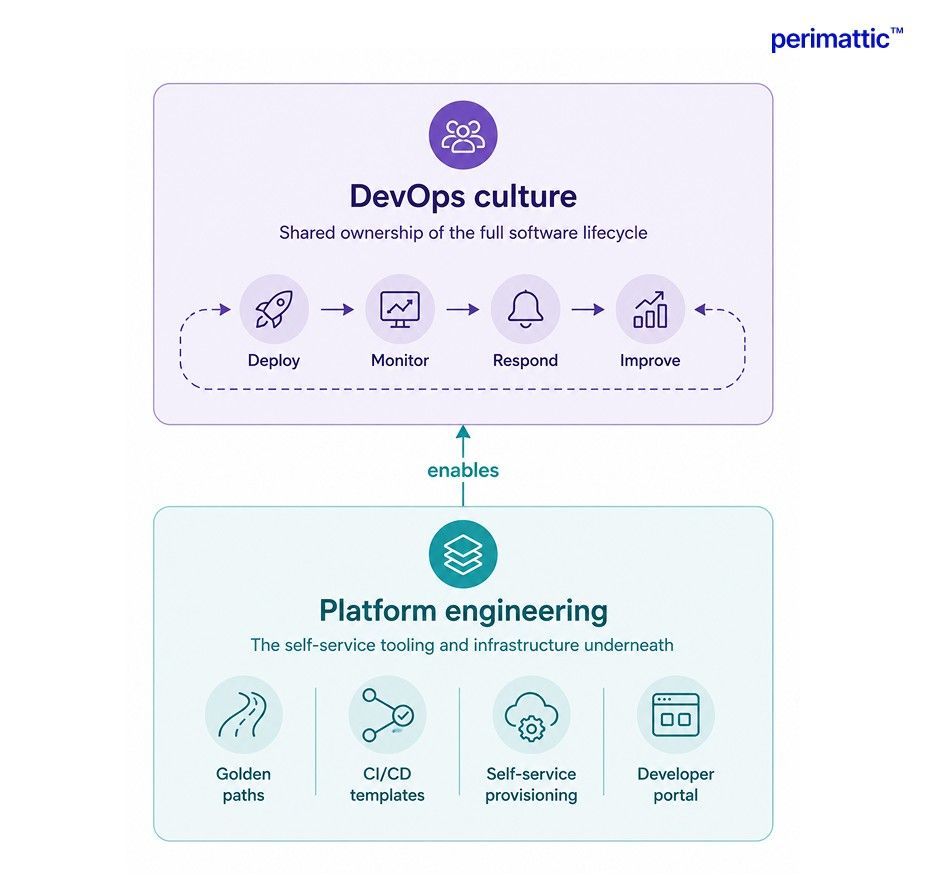
In a healthy engineering organization, DevOps and platform engineering aren't competing approaches, they're layered. DevOps sets the cultural expectation: teams own the full lifecycle of what they build, from code to production and beyond. Platform engineering builds the infrastructure that makes that ownership sustainable as the organization grows, in much the same way DevOps itself tends to show up as one thread within a broader digital transformation strategy rather than a standalone initiative.
Think of it this way: DevOps is the destination, fast, reliable, collaborative software delivery. Platform engineering is increasingly how organizations get there once the old approach of "every team builds its own path" stops scaling. Product teams still practice DevOps daily, deploying their own code, watching their own dashboards, and responding to their own incidents. They just do it standing on a platform that a dedicated team built and maintains specifically so they can focus on product work instead of plumbing.
Conclusion
The same principle applies when evaluating an existing platform. Adoption matters more than the number of tools in the stack. A platform with extensive infrastructure capabilities but low developer adoption is not necessarily solving the underlying problem. The strongest platforms are the ones developers choose to use because they make common engineering tasks faster, clearer, and more predictable.
If you're evaluating whether your organization needs a dedicated platform team, the clearest signal isn't headcount. It's how much time your developers currently spend on infrastructure work that has nothing to do with the product they're actually trying to ship. And if that capacity doesn't exist in-house yet, DevOps as a Service is one way to bring in platform-building expertise without committing to a full internal team on day one.