
 Brandnata + UnicommerceLogistics & ops
Unicommerce orders and returns, turned into profit by SKU
Brandnata connects to Unicommerce through a dedicated API user that you create in Uniware, whose credentials Brandnata uses to request an access token from your Unicommerce tenant, in about 5 minutes. The connection is read-only by default, and Unicommerce data is reconciled with every other channel you connect in one dashboard.
Brandnata's Unicommerce integration reads sale orders, shipping packages, returns and inventory from your Uniware account, across every marketplace and storefront you manage there. Those orders are combined with marketplace fees, courier and RTO costs and ad spend from your other connections, giving you profit by SKU and channel, not just order volume.
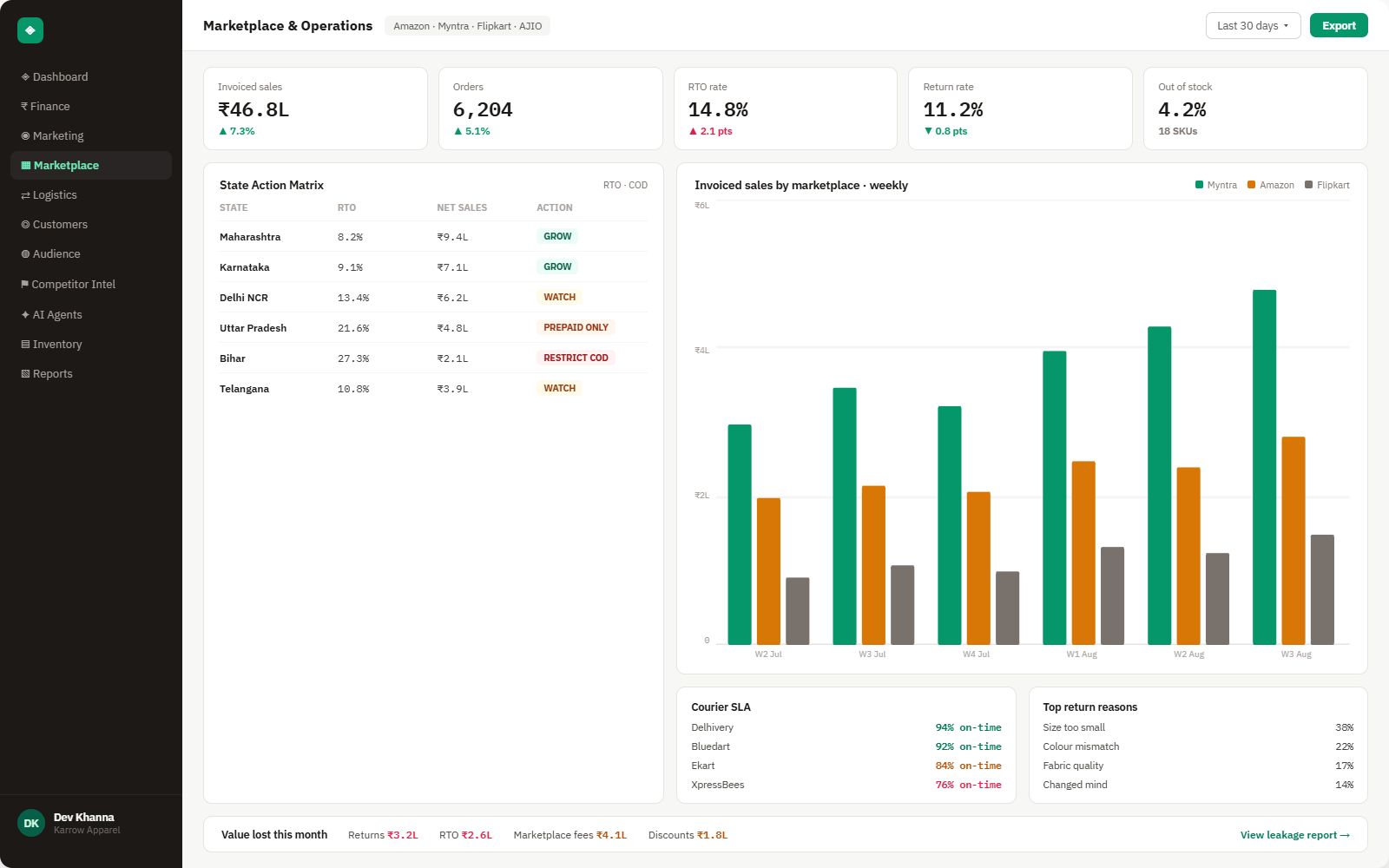
Everything Unicommerce sends into Brandnata
Once connected, sale orders, shipping packages and returns sync throughout the day, and inventory levels update on each sync.

Sale orders
Orders from every channel connected to Unicommerce, with SKU, selling price, channel, status and order date.
Shipping packages
Packages with courier, dispatch and delivery status, used to measure fulfillment speed by facility and channel.
Returns & RTO
Customer returns and orders returned to origin, kept apart because each costs a brand money in a different way.
Inventory
Stock by SKU and facility, so profit sits beside the inventory you hold for each product.
How Brandnata uses Unicommerce data
Unicommerce is the operations layer: it knows what sold and shipped on each channel and what came back. Brandnata adds the costs that live elsewhere, such as marketplace fees from Amazon and Flipkart, courier charges from Shiprocket or Delhivery and ad spend, to turn those orders into profit by SKU, channel and month.

Unicommerce data feeds Brandnata's anomaly alerts and AI agent suggestions. The connection itself only reads data and never changes anything in Unicommerce.
What you can do with Unicommerce in Brandnata
Specific, Unicommerce-native use cases, not a generic list that applies to every connector the same way.
See which products, channels and pin codes lose the most to RTO and returns once the forward and reverse shipping costs are counted.
Unicommerce has no ad data. Brandnata puts Meta Ads, Google Ads and Amazon Ads spend beside the orders, so contribution margin includes marketing.
Order and return data from the same system the warehouse uses, which keeps finance numbers aligned with what was actually shipped.
Where Brandnata + Unicommerce fits
Other ways teams currently piece this data together, and where each one runs out of reach.
| Approach | Coverage | Where it falls short |
|---|---|---|
| Brandnata + Unicommerce · this page | Orders and returns from every Unicommerce channel combined with fees, courier and RTO costs and ad spend, giving profit by SKU and channel | N/A |
| Unicommerce reports and reconciliation (native) | Order, inventory and return reports, plus payment reconciliation for major marketplaces and product-cost P&L | No ad spend from Meta, Google or Amazon Ads, so profit stops before marketing costs |
| Other OMS tools (EasyEcom, Vinculum) | Order management with reconciliation modules, sometimes licensed separately | Built around operations and settlements, with the same gap on advertising costs |
| Exports in spreadsheets | Unicommerce order and return exports matched with settlement and ad reports | Slow at high order volumes, and returns from an earlier month are easy to miss |
Unicommerce works alongside every other connector
Data from Unicommerce doesn't sit in isolation, it's matched against orders, customers and spend from every other platform you connect, so the full picture shows up automatically.
Related connectors
Brands using Unicommerce usually connect these too.
Orders, returns, RTO and settlement deductions, with net profit per order.
Marketplace sales, fees, ads and inventory across every Amazon region.

Shipments, delivery performance and fulfillment, tied to every order.

Delhivery shipments, freight, NDRs, RTOs and COD remittances, tied back to the orders they belong to.
Unicommerce integration FAQs
How do I connect Unicommerce to Brandnata?
In Uniware, create a separate user for Brandnata with access to the facilities you want reported, and set its password. Enter your Unicommerce tenant name and that user's credentials in Brandnata, which uses them to request an access token from your tenant. Disabling the user in Uniware ends access.
Does Unicommerce have an API?
Yes. Unicommerce's Uniware platform has REST APIs for sale orders, shipping packages, returns and inventory. Access uses an OAuth token issued by your own tenant URL, which expires and is refreshed automatically.
What is the difference between Unicommerce and Uniware?
Unicommerce is the company. Uniware is the name of its order and warehouse management platform, which is what sellers log in to and what the API connects to.
Does Unicommerce show profit after ad spend?
No. Unicommerce can reconcile marketplace payments and calculate a basic profit per item if you enter product costs, but it has no data from ad platforms. Brandnata adds ad spend so profit includes the cost of acquiring each order.
Does Unicommerce do payment reconciliation?
Yes, for major marketplaces, through its payments dashboard and its reconciliation product. Brandnata doesn't replace that work. It uses order and return data from Unicommerce together with fees and ad spend to answer a different question: which products and channels make money.
Can Brandnata separate RTO from customer returns?
Yes. Unicommerce records returns to origin and customer returns separately, and Brandnata keeps them apart, because an RTO costs forward and return shipping on a sale that never happened, while a customer return also reverses revenue.
Can Brandnata change orders or inventory in Unicommerce?
No. Brandnata reads sale orders, shipping packages, returns and inventory. It doesn't create or cancel orders, update stock or change listings on any channel.

Connect Unicommerce in about 5 minutes
Connects through a dedicated API user that you create in Uniware, whose credentials Brandnata uses to request an access token from your Unicommerce tenant. Read-only to start, with your first reconciled numbers within a day.